

![[Parallel Wars] Edition XII: “Pack your things, we’re leaving!” | Fandom](data:image/gif;base64,R0lGODlhAQABAIAAAAAAAP///yH5BAEAAAAALAAAAAABAAEAAAIBRAA7)
Hello people of Wookiepedia! Welcome to the XII edition of Parallel Wars! This series was created with the purpose of fomenting edifying and mature discussions about real life topics which can be compared or have a strong link to Star Wars topics.
If you have any questions or you just want to browse past editions, please feel free to check the archive below.
Before I start, I just wanted to thank my amazing friend @Ajjviolin96 for coming up with the idea of the creation of this wonderful series, and I wanted to thank as well all the people who have shared their views on the various topics in the previous editions, whether they hosted them or not. I’d also like to apologize for taking so much time in posting this new edition, but personal business has kept me away from the forum. Thank you for your patience in waiting for this. I’m really excited to be giving my contribution to this series, so without any further ados, let’s jump right into it!
The topic I propose to you today is, if you wish, a fairly trivial and banal one, considering the philosophical (and boring lol) stuff I usually write. Despite that, this essay is about something that we’ve all done at least once in our lives and it is surely about an action that most people enjoy doing, even though in the past few years the recent pandemic has truly limited our chances to do what today’s topic suggests. Nevertheless, nothing can truly stop you from doing what we’re going to talk about later on, if you have enough imagination or introspective skills. Going straight to the heart of the matter, this edition’s topic will be travelling.
Travelling is one of the most ancient activities practiced by men, that was almost born with humankind itself: infact, in ancient times, the first men were nomads, who had to move from place to place whenever there wasn’t enough food or water to sustain their tribe or when the resources of the soil in a certain region were no longer exploitable.The first forms of association and political life (which in this case denotes the number of activities performed in the context of a social structure, and therefore also a city) were born when, of course, men started establishing social relationships between each other, but also when they found out they could plant and harvest some crops, and thus they could settle stably in a land. Despite that, even with the evolution and improvement of stable homes and the growth of inhabited centers with new structures and meeting points (like squares, markets etc.), travelling has remained one of the most important human activities: whether it was for discovery and exploration (like Columbus and Magellan’s case) or for documentation purposes (the Greek “reporter” Herodotus is a honorable mention), for metaphysical purposes (like pilgrimages) or for work, for pleasure and relaxation or out of necessity (like Biblical exodus and migrations), we still travel to this day for the most various reasons. And to be fair, travelling is one of the best experiences one could ever have.

Primer desembarco de Cristóbal Colón en América 1862 Dióscoro Puebla- Prado Museum
That being said, travelling isn’t something necessarily physical, as I’ve already pointed out, but it can also be metaphorical: not only there is a great part of literature inspired by this topic, to the point that “travel literature” is now a widely appreciated subgenre (whether those books are fantastic, historical or scientific: e.g. The travels of Marco Polo or Verne’s Around the World in Eighty Days), but the term “travel” can also denote a “spiritual trip”, an introspective journey, which can be considered part of the processes of psychoanalysis.

'Around the World in Eighty Days' by Neuville and Benett
Now, I personally think there would be so many interesting aspects to consider, when analyzing this topic, but unfortunately, I have to choose only one. Nevertheless, you will probably have a lot to think and write about ;P
Hence, to me, the topic of travelling is best represented by two characters who have both travelled a lot and who share an exceptional and endearing story: Odysseus and Revan.

Ulysse reconnu par sa nourrice à son retour de Troie 1849 William-Adolphe Bouguereau - Musée des Beaux Arts, La Rochelle

Revan as a Jedi
I know that at first, these men don’t seem to have anything in common, but I assure you that there are quite a few similarities between the two.
First of all, they both have an obscure and mysterious past: if it is difficult to track back the original place in which Odysseus was born, that’s an even harder task if we’re talking about Revan. In the 14th book of the Odyssey, Odysseus says himself that he comes from Crete, and he is indeed remembered among the Cretan chiefs of the Trojan war. According to Paul Faure’s studies, he is truly Cretan because of various elements that confirm this theory (I won’t talk about this for the sake of brevity). But according to the most famous tradition, Odysseus was the king of Ithaca and therefore he came from that place. Despite that, he might also be from Boeotia, Corinth, Sparta, or Arcadia. Similarly, it is difficult to pinpoint the exact place where Revan was born: we can only say with some level of certainty that he might have been born in the Outer Rim territories, but nothing more is known about the location of Revan’s birth. In addition to this though, I feel like a remarkable detail that needs to be pointed out is how both Odysseus and Revan had a faithful companion who stood by their side during wartime: Diomedes, king of Argos and Alek, later known as Malak.

Revan and Malak after the Mandalorian Wars
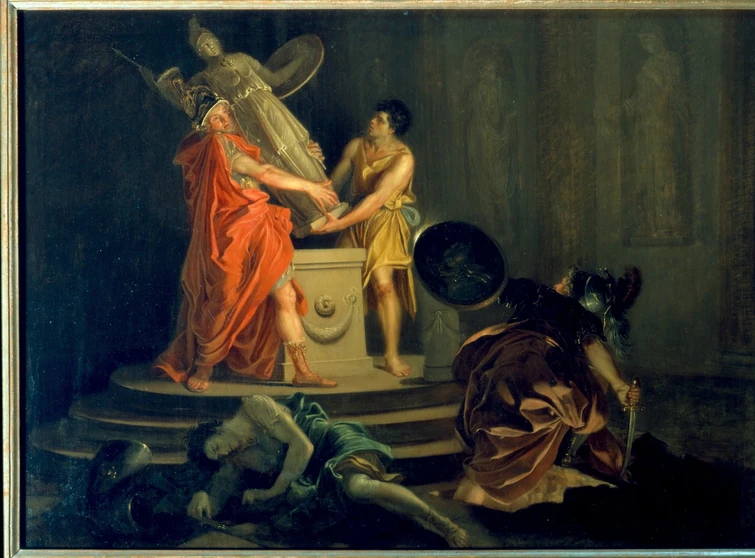
Ulisse e Diomede rubano il Palladio 1783 Gaspare Landi, Galleria Nazionale di Parma
Despite these similarities, what really unites these two characters is one fundamental element: the fact that, throughout their lives, they’ve both travelled a lot for the most various reasons. Their journeys, in the first place, started because of a war: infact, Odysseus had to leave his family behind to move to Troy, and help the Achaens win the war, while Revan decided to lead a literal crusade to the Republic’s territories in the Outer Rim, which were being threatened by Mandalorian warriors. During these wars, which have been turning points both in our history, and in the galaxy’s history, the two heroes and their mates (Alek and Diomedes) have stood out for many of their deeds, thanks to which they proved to be valiant warriors and cunning schemers (Homer would have said “Ἄνδρα πολύτροπον” which means “resourceful man”: another trait that Odysseus and Revan share with each other). In the end, the war was won with a devious move, which led to the decimation of the Trojan dynasty and of the Mandalorian people: the trick of the Trojan Horse and the construction and activation of the Mass Shadow Generator.
With the end of the war, the most interesting part of the vicissitudes of the two characters begins: infact both Odysseus’ and Revan’s peregrinations will start, and they will come to an end in an extremely long time, if we want to assume they actually ended at some point.
Now, something I’d like to state before carrying on with my dissertation is that the journeys of these two characters were evidently induced by necessity, of course, but most importantly, they were urged by curiosity: Odysseus was not only persecuted by Poseidon who made him wander around the known world to keep him from returning home safe and sound; he was curious to explore every land, to see every prodigy, to know every kind of man, to find out what was over the famed Pillars of Hercules. Similarly, Revan was curious to discover the mysteries that laid in the unknown regions, to understand the greater truths of the Force, to prevent a catastrophe from happening. His curiosity had even been noticed by one of his masters, Lestin, who thought it was just a sign of his exuberance. His view, though, was also shared by master Vandar and Master Vrook, who started getting concerned. The only person who could somehow quench Revan’s insatiable thirst for knowledge was Kreia, who got blamed for the Jedi’s fall to the dark side. Eventually, both these characters’ curiosity led them to their demise. But I will get to this later.
Now, let’s start from the beginning. For comprehension purposes I will divide the narration of the two trips into sections. Keep in mind that the original subsections of the Odyssey, which correspond to the places visited by Odysseus are twelve. I won’t keep the same scheme as I will examine the journey in general terms, and make comparisons when possible. If they sometimes seem too forced, please consider that we should compare themes and not actual events, despite the similarities:
The aftermath of the war and the beginning of the journey: after defeating the Trojans with the trick of the horse, and dividing the spoils of war, Odysseus is ready to leave Troy with his mates to go back to Ithaca. On the other hand, Revan decides that he won’t go back to the Jedi council to be judged for his actions. Unlike Meetra (who in this case represents all the Achaen chiefs who got back from the journey but had to meet justice and be punished in different ways for their actions), Malak and him will head towards the Unknown regions, to prove the truthfulness of Mandalore the Ultimate’s words.

Revan fighting against Mandalore
The first destination: while Odysseus docks at the island of the Cicones, Revan and Malak arrive on Rekkiad. The heroes plunder the places they’re at for some goods they need: Odysseus enslaves some women and steals some riches. However his mates disobey his orders, so he gets attacked by the Cicones and he’s forced to flee. Revan retrieves the datacron of the Sith Lord Dramath the Second, which leads him to Nathema. Before departing, he hides Mandalore’s mask in the tomb. Later on he’ll reclaim this object which will prove quite useful, just as Odysseus will get an amphora full of wine which he will later use against Polyphemus. Ever since the beginning of these stories, one element in particular becomes evident: the disobedience of the mates towards the main characters.As time goes on, Malak and Odysseus’companions will grow more skeptical and intolerant regarding the heroes’ decisions and choices: this, matched with their poor wit and foresight, will lead to their demise. Instead the heroes’ curiosity and intelligence will be their salvation.
The second destination: as for the following places the protagonists visit, I’d say they are both connected with the theme of “oblivion”. Infact, Odysseus reaches the land of the lotus-eaters who used to eat lotus fruits and flowers, which made them sleep peacefully. Therefore, the whole island seems to be crystallized in the state of a deep slumber, which makes everyone forget all their memories. Some of Odysseus’ mates eat the fruit and forget their homes and identities:that was the worst fate they could suffer, considering that the Odyssey is the poem of memory and homecoming. Eventually Odysseus leaves the island with the remaining people. Revan and Malak instead reach Nathema, a planet stripped of the Force, and devoid of any life forms. This place has reached such a state of oblivion that not even the Sith remember it. Despite that, Revan finds out that it was the former home planet of the Sith Lord VItiate, who had performed a ritual on it, turning it into its actual state. Vitiate had then taken on the title of Sith Emperor, and after a long exodus, he, and his loyal Sith reached Dromund Kaas. At this point I think it is already noticeable how important the theme of knowledge is: in this case it is not some general kind of knowledge but the one that revolves around the possession of oneself, the secrets of the human mind and of the mechanisms of force and power, and the truths that the surrounding world hides. Nevertheless, even though Odysseus and Revan are moved by their curiosity, they will fully realize this aspect of themselves only later in their journeys.
The third destination: this is a meaningful turning point in both the stories. Odysseus lands on the island of the Cyclopes, where he meets Polyphemus, son of Poseidon. He’s described as a man eater (a trait he has in common with Vitiate if you wish, since he absorbs the energy of the living creatures around him) and thus, he will eat some of Odysseus’ mates. To escape from his cave the hero will get him drunk with the wine he got from the Cicones and, with the help of his mates, he will blind him by hardening a sharp wooden stake in the fire and stabbing the cyclop’s eye. When the giant asks for his name he will reply with "Οὖτις", another way to say nobody alongside οὐδείς which is assonant to Odysseus’ name. By tying himself and his companions under the bellies of Polyphemus’ sheeps, he gets the Cyclop to open the entrance of his cave, and he is able to escape. At this point he will attract on himself the curse of Poseidon. Meanwhile Revan and Malak reach Dromund Kaas, the capital of the Sith Empire, ruled by Vitiate. Posing as mercenaries (a trick that corresponds to the name deceit in the Odyssey) they find out that the Sith are planning to invade the Republic. Therefore they manage to get into the Throne Room with an Imperial guard’s help. But the Emperor has set a trap for the two heroes; thus he twists their minds, fully “baptizing” them to the dark side, and gives them a new task: finding the Star Forge. This episode shows clearly how powerful the Emperor is: and indeed he is some kind of Polyphemus, whose powers and forces are fully disproportioned to Revan’s ones. He is easily capable of dominating and annihilating men, and he somehow is of divine descent. Even Dromund Kaas itself is a “barbarian” place, with a different culture and different traditions that might seem brutal to strangers. According to some kind of environmental determinism, the air of the planet is electric, stormy and deadly, as dangerous as the island of the Cyclops, who should represent volcanoes, violent and possibly lethal forces of nature.

L’accecamento di Polifemo 1550-51 Pellegrino Tibaldi, Palazzo Poggi, Bologna

Revan and Malak meet the Emperor in the Throne Room
The fourth destination: after gathering pieces of star maps on Dantooine, Kashyyyk, Manaan, Tatooine and Korriban, Revan and Malak get to Lehon or Rakata Prime, the location of the Star Forge.This remote island is inhabited by the once powerful and force sensitive Rakata specie, which after a past of glory, has succumbed to dreadful practices like cannibalism. Revan is taken captive but he is able to drain some information about the Elders from the One. He then reaches a compromise with them: the Elders will open the Temple of Ancients for him as long as he destroys the Star Forge. However Revan breaks his promise, and aided by Malak, he accesses the Star Forge. Freed from the Emperor’s control, they turn spontaneously to the dark side, becoming Sith lords. But Malak gets evidently intolerant to Revan’s teachings and orders, so he openly disobeys him by telling Saul Karath to bombard Telos. In the end, their troubled relationship fuels a duel between them, which ends in Malak losing his jaw to Revan’s lightsaber’s strikes. On the other hand,Odysseus reaches the island of Aeolus, a man whose origins might be divine. Like the Rakata he also commits barbaric practices, like incest with his children. Even if he’s part of a primitive society and he has a dark past, the gods allowed him to live on a free and remote island exactly like the aforementioned species,As well as the Elders, Aeolus is ready to give up something as long as Odysseus keeps a promise: he gives him a goatskin filled with averse winds that will impede his navigation to Ithaca. But in exchange, the hero must not open the recipient. Odysseus’ mates, who are getting more and more disobedient as time goes on (like Malak after all), open the goatskin and release the winds that push their boats away from home. At this point Revan and Odysseus will fall victims of an ambush and they’ll be amongst the very few survivors: Revan will be attacked by a Jedi strike force led by Bastila Shan, who will save his life even though she will allow his identity to be wiped by the Jedi Council on Dantooine; Odysseus will be attacked by the Lestrigonians, monstrous creatures who will kill most of his companions.

Bastila Shan and the Jedi strike team
A new beginning: at this point, it’s time to prove how Revan’s peregrinations are just a perpetuous Odyssey, a journey in which he’s forced to go back on his steps and retrace his path to find himself all over again. In the end it’s something Odysseus does as well, according to the principle of “over-assimilation” and “under-assimilation”: he is always forced to remodel his status, and only at the end of the journey he will fully regain possession of his whole identity of husband, father, king and hero. I’ll try to be as short as possible for this part since there are no significant similarities between the two journeys (and the comparison here might get even more forced than it possibly is ), although I think that we can still find some interesting links between them. I’d say this section is characterized by the theme of “oblivion” all over again (notice how the themes are starting to be recurring; we are getting to one of the essay’s key points): Revan gets his memory wiped, while Odysseus makes some sweet encounters that will make him forget his duties and promises towards his wife and motherland. But let’s proceed step by step. As Odysseus faces unfathomable dangers and meets interesting and unusual creatures (such as the sirens and Scylla and Charybdis, that in Revan’s story represent the lure of the dark side and the possibility that it could swallow his good side), along with two women that will make him put aside for some time his goal to go back home and regain his identity, Revan has lost memory of himself as well. The Jedi have wiped all of his memories and they have given him the new identity of a Republic soldier. But even though Revan doesn’t know who he really is, his quest for the Star Forge and his closeness to some people that somehow were involved in his past or have been inspired by him, will lead him to not only retrace his steps, but also to gain consciousness about his old self. And while Odysseus’s crew will get less and less numerous, Revan will make new friends along the way, such as Carth Onasi, Mission Vao and Zaalbar, Juhani, Canderous Ordo, HK-47,Jolee Bindo and T3-M4. But the most important person both in his life and in his journey will be a woman, Bastila Shan who can be considered a character who shares some traits with all of the women that Odysseus meets in his way: just like Circe she is proficient in “magic techniques'' (force powers and battle meditation in this case lol), that might affect the people around her in both good and bad ways. Bastila is as mysteriously attractive and potentially dangerous as the beautiful enchantress: infact, she will turn to the dark side, underlining the fact that she possesses a deeper knowledge of the Force, even the one that is considered to be “prohibited”. And as Circe is the one who helps Odysseus enter the reign of the dead, where he will learn his future by the shadows that inhabit it, Bastila’s presence will induce some dreams and visions in Revan, that, triggered by the “shadows of the past”, will open some sort of “inaccessible underworld” that will be the key to discovering the future and the past. At the same time though, Bastila shares with Calypso her struggle between love and duty: even though she will grow fond of Revan (just like the nymph and Odysseus), she knows that they can’t be together because of her role and because of his past. She loves Revan deeply but she’s also conscious of the fact that she should let him go because their relationship is no good. Other than that, the two women share their mysterious and puzzling personality: the name of Calypso, infact, means “to hide, to conceal” (from the greek verb καλύπτω) , and indeed Bastila knows the truth about Revan’s true identity but she hides it for most of the journey’s duration. Last but not least, Bastila can also be compared to Penelope, Odysseus’ wife, because just like her, she is an alter ego of her lover, to the point that she shares a deep Force bond with him. Besides. just like the queen of Ithaca, even Bastila experiences recurring dreams and visions about her lover.

A Fantastic cave with Odysseus and Calypso 1616 Jan Brueghel the Elder-Johnny van Haeften Gallery, London
The end of the journey and the last trials: after visiting Taris, Dantooine, Tatooine and Kashyyyk for the second time and retrieving the missing pieces of the star map, Revan visits the last planet before getting to the end of his journey: Korriban. Now, Korriban of course has had its great deal of importance in Star Wars lore. And indeed, it is quite an important step in Revan’s trip as well. Something that needs to be pointed out is this: while Revan is on Korriban, Odysseus gets to Scheria, an island inhabited by the Phaecians. These two places have quite a few things in common, but at the same time they differ a lot: infact they both exist in a separate way from the “known world”, as Scheria is an utopian island blessed by the gods and Korriban is the mysterious and dystopian land inhabited by the Sith (pureblood and not). But while Scheria is a peaceful and prosperous place, ruled by the just king Alcinous, Korriban is led by the Sith lords, that had been helped by some dark Jedi, who were indeed seen as gods: nonetheless the planet is a cruel and ruthless place, where to survive, not to say become a Sith, the “hopefuls” have to undergo many lethal trials. And while the Phaecians prove to be kind and friendly people, who give Odysseus a ship without even asking for his identity, the aspiring Sith, fight against each other to gain a place in the academy, involving Revan (whose identity remains a mystery) in their struggle for survival.To be fair, Scheria shares some similarities with Lehon as well, but I will overlook this. After going back to Rakata Prime, Revan manages to board the Star Forge, where he confronts his old friend and ally, Darth Malak, who has claimed the mantle of Sith Lord for himself , believing that his fellow Jedi and old master had died. At the same time, Odysseus finally reaches Ithaca where the suitors of Penelope are laying waste to his palace, ready to gain the vacant title of king of Ithaca (since Odysseus’s son would still have to fight his way to earn it), after the hero’s supposed death. At the end of the journey both main characters reach their last destination as changed man, under a false identity: Revan is so close to become himself again and set things down with his past, but he is still in an uncertain position, neither good nor bad, neither light nor dark. At the moment, he is nobody. Odysseus as well, reaches Ithaca under the disguise of an old beggar, but until then he has never been so close to his homeland and to the end of his journey. So while the latter slains the Suitors aided by his son Telemachus, and finally frees Ithaca and Penelope from them, the former defeats the hostile Rakata and eventually Malak, ultimately being able to leave the past behind, especially the most obscure moments of his fall to the dark side. After Odysseus completes successfully Penelope’s trial regarding the description of the bed he had built, he can finally take back his place, just as Revan, who after redeeming Bastila, can regain his role and identity as hero and savior of the galaxy, Jedi Knight and, of course, Bastila’s lover.

Ulisse alla corte di Alcinoo 1814 Francesco Hayez - National Museum of Capodimonte

Malak defeated by Revan on the Star Forge
And so our journey ends here. Or does it? Well actually it doesn’t indeed. Infact in the 11th book of the Odyssey Tiresias predicts that Odysseus will die “ex halos”, which means that his death will come “from the sea” or will occur “far from the sea”. From this interpretation many other myths were born, including the one according to which Odysseus left Ithaca again to explore the unknown world beyond the Pillars of Hercules. But according to a poem by a 19th century Italian poet, that I will cite here because to me it describes a situation closer to Revan’s own journey, Odysseus will leave his homeland again, 10 years after the events of the Odyssey. He will visit again all the places he had seen during his peregrinations, but he’ll notice that the reality doesn’t correspond to his memories anymore and therefore he will shipwreck near the island of the sirens, and his body will be carried by the waves to Calypso’s island. That’s almost the same fate Revan will suffer: two years after Malak’s defeat, the Jedi will be tormented by visions of a storm covered world, that will force him to retrace his path and his steps to find the source of the evil force he had been dreaming of. In doing so, Revan left Bastila and their yet unborn child behind (just as Odysseus left Penelope and Telemachus when he had to sail to Troy) to pursue his plans. After going back to the planets he had visited with Alek first, and with his crew then, he will reach Dromund Kaas, where the Emperor will defeat him and imprison him, condemning Revan to stay with him forever. So, even the Jedi’s demise occurred far away from home.
To conclude my far too long dissertation, I think that now it is clear why Revan’s and Odysseus’ journeys are similar: they were both induced by the curiosity and the desire for knowledge of the main characters, they both lead the heroes down a path of virtue, horrors, lost memories, forgetfulness, knowledge and heroic deeds. They were both full of visions, dreams and prophecies. They both allowed Revan and Odysseus to see every kind of men (and aliens lol), and to deeper understand the human nature and that of the fate (or the force); and at the end of their long trips, filled with sufferance, pain, love, friendship, deceit, loyalty, betrayal, trials and disobedience, both Odysseus and Revan finally regained possession of their identity as a whole, enriched by new experiences.
That being said, our journey ends here (for real this time though). Thank you for reading all the way up until here! Now it is your turn: according to you, what does best express the topic of travelling in Star Wars? Jump in the comment section below and share your ideas! And until the next time… may the Force be with you!