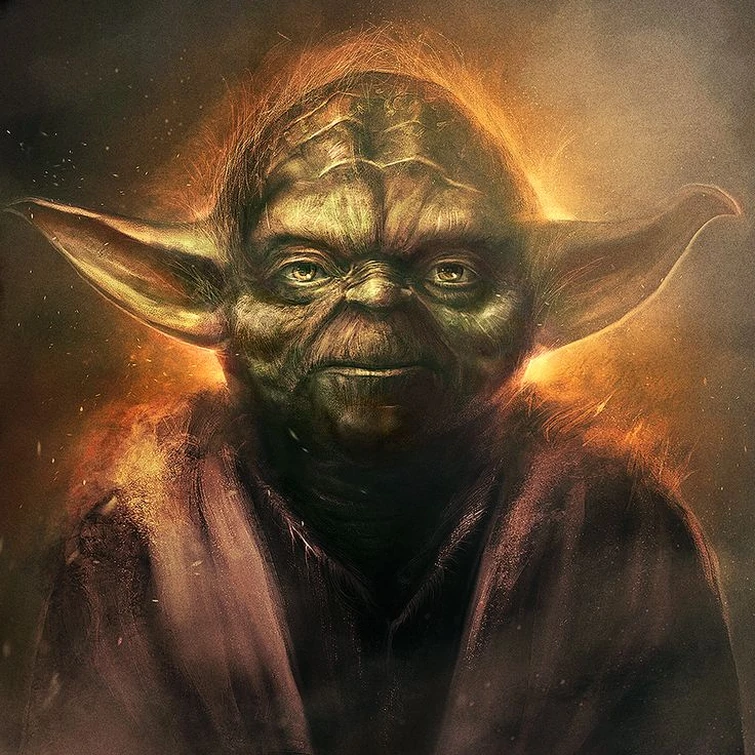
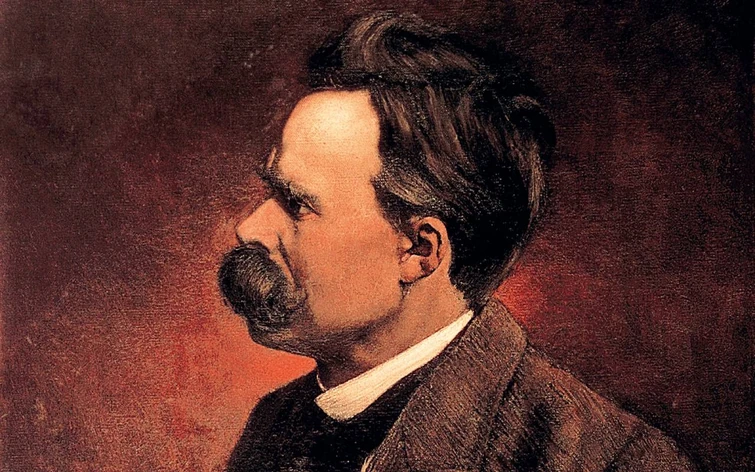
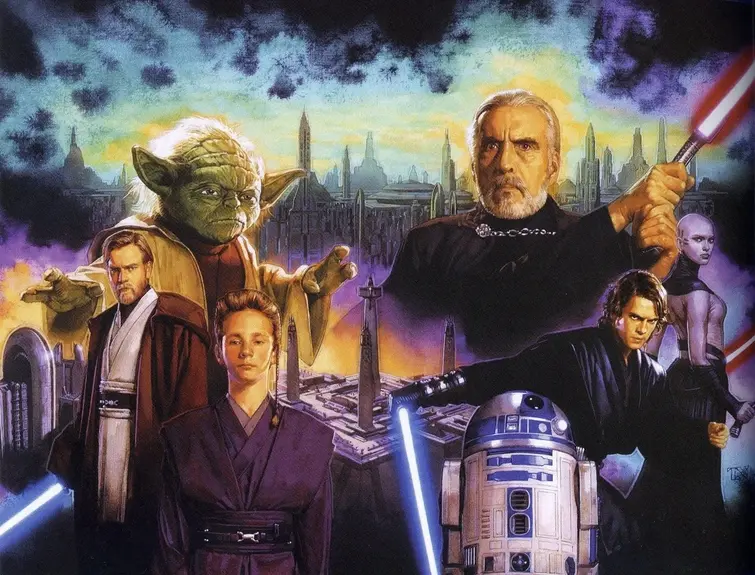
When it comes to this concept, the term “power” here means “the power to become.” All people, things, everything in the universe possesses a will to power. The meaning of “will” should not be understood as a “human” feeling. Nietzsche speaks of how things, in order to exist, struggle to exist. From the smallest and most insignificant atom to vast constellations and galaxies. An existence that, in turn, is always changing, always capable of “becoming.” From a psychological perspective, this is easier to understand. According to Nietzsche, if there’s one thing all human beings have in common, it is our will to power. Beyond morality, right and wrong, what we truly desire is “power.” And this desire for power manifests itself in many ways. From the power a dictator seeks to control over everything and everyone, to the person who wants the power to live a peaceful life in the middle of nowhere.
The point is that we are always seeking this form of power that makes our lives become other things. So that life moves on, continues, proliferates. Even if it is in the paradoxical direction of a life that seeks its own end (as it is the case with depressed, destructive people, etc.); even they seek this power that exists in life, even if it is through the destruction of life itself, which is still a power, something best explored by Nietzsche through the dualism between the Apollonian and the Dionysian (another concept to be discussed in another dissertation).
- Dooku: “Forgive my comments on the Temple. You know I have never doubted your goodness. But – and I say this with all respect – there are things you choose not to see, Master. The Jedi principles – your principles – are noble ones, but the Jedi have become a tool in the hands of a corrupt Republic. If you truly want to see real justice…”
Yoda looked up and met Dooku’s eyes with a look of such infinite, distant boredom that the Count’s speech staggered to a halt.
- Yoda: “No lies for me, Dooku. Through the motions, do not go. No Sora Bulq am I, to be caught in a web made of ideals. Pfeh. Thin stuff. Save it for the young. I am not young. The old, easily bored are. Even Yoda, though I try not to hurt feelings by showing it. But come across the galaxy to hear you tell me about nobility and justice?”
Yoda laughed. It was by far the tiredest, bitterest, most unpleasant sound Dooku had ever heard him make. He had thought he was beyond shock: but the disgust in Yoda’s voice was shocking to him.
Yoda looked down at the floor, making little patterns in the air with his stick: “Something real, tell me about. Show me another way we can end this war. Tell me something Dooku knows that Yoda does not.” The Count looked at Yoda, baffled. “Come across the galaxy I have for one thing, Dooku.”
- D.: “Yes, Master?” Dooku said, hating the words as soon as they were out of his mouth. He only had one Master now, and a jealous one.
- Y.: “Obvious is it not, Dooku?” And then Yoda was doing it to him again – the unexpected lurch, his balance gone, and the world turned inside out as Yoda said, “Turn me, Dooku, I beg you. Show me the greatness of the dark side.”
(Stewart Sean, 2004, Star Wars: Yoda: Dark Rendezvous, pgs. 297-298).
Because the concept of will to power is per se amoral, both the Sith and the Jedi – in the macro perspective as institutions and in the micro perspective of its members, as individuals – possess will to power. The main difference lies in how that manifests according to each Order. The Sith believe that “true” will to power is what the dark side offers them: to free themselves of societal norms, of everything that belittles them; to break the chains of humanist moralism (illuminist humanism) that domesticates their souls; to get rid of the parasitic compassion that plagues the hypocritical society; and above all else – to bend the “will of the gods” (the Force) to their own will. They don’t believe that Tragedy is a metaphor of life because they don’t believe that fate is out of their control. They want the “power to become” fate incarnate.
All these elements, ironically, are semantically close with another Nietzschean concept which is the “Übermensch” (again, something to be developed in another future essay), which all Sith Lords, in a higher or lesser degree, share and manifest in their character and way of thinking. Dooku is not an exception, although his “drama queen” complex unconsciously prevents him to fully embrace that (all Sith Lords are resentful divas, but Dooku was one of the worst). That is what he’s trying to sell Yoda, albeit unsuccessfully.
- Dooku: “You want me to tell you about the power of the dark side?”
Yoda had the dragon’s eyes again: half closed, gleaming under heavy lids. - “Strong, strong the dark side is in this place. Touch it you can, like a serpent’s belly sliding under your hand. Taste it, like blood in the air… tell me of the dark side, apprentice.”
- D.: “I’m not your apprentice anymore,”
Yoda snuffed; laughed; stirred the air with his crooked stick. “You think Yoda stops teaching, just because his student does not want to hear? Yoda a teacher is. Yoda teaches like drunkards drink. Like killers kill. But now, you be the teacher, Dooku. Tell me: is it hard to find the power of the dark side?”
- D.: “No. The lore of the Sith – that is another matter. But to touch the power of the dark side, to begin to know it, all you have to do is… allow yourself. Relax. We carry the dark side within ourselves. Surely you must know that by now. Surely even Yoda has felt it. Half of life, dark to balance light, waits inside you like an orphan. Waiting to be welcomed home. We all desire, Yoda. We all fear. We are all beset. A Jedi learns how to suppress these things, to ignore these things – to pretend they don’t exist, or if they do, they apply to someone else, not us. Not the pure. Not the Protectors. To know the dark side is merely to stop lying. Stop pretending you don’t want what you want. Stop pretending you don’t fear what you fear. Half the day is night, Master Yoda. To see truly, you have to learn to see in the dark.
- Y.: “Mmmmmmmm. The dark side, power would give me.”
- D.: “Power over all. When you understand your own evils and the evils of others, it makes them pitifully easy to manipulate. It’s another kind of push-feather. The dark side will show you the stiff places in a being. His dreads and needs. The dark side gives you the keys to him.”
- Y.: “Hmph. Very fine that is, but Yoda has power. I live in a palace bigger than this one, if I count the Temple as a palace. Dooku is a master of armies, but Yoda is a master of armies, too. So far, we are even.”
- D.: “Is there such a thing as too much power? For instance, there was a day when your power was clearly greater than mine. Today, however, I have waxed as you have waned. You stand in my citadel. I have at my command servants and droids and great powers of my own that I think would overwhelm even you. It is possible that at a single word, I could have you killed. And without you, how long would those dear to you last? I could have them, one by one: Mace and Iron Hand, Obi-Wan and precious young Skywalker, too. Surely you would feel safer of this were not so.”
- Y.: “Like Anakin, you do not?”
- D.: “Perhaps he reminds me too much of myself at the same age. Arrogant. Impulsive. Proud. I realize humility is high among the Enforced Virtues, the ones no one acquires by choice; but that being said, if Fate is looking for an instrument to humble Skywalker, I confess myself willing to volunteer.”
Yoda reached behind his back with his stick, trying to scratch a spot just between his shoulder blades. “Power over beings, need I not. What else can it give me, this dark side of yours?"
- Dooku: “What game are you playing here, Master Yoda?”
Yoda smiled at the use of the term Master – curse him – and shrugged. “No game. Wasteful, this war is. Even you agree. Sent you the candle, did I: you know there can be coming home for you. Know this, both of us do, and if come back to the Temple you wish, I will take you there.”
- D.: “Very kind. Decent of you to give me an arm to lean on.”
- Y.: “Always catch you I will, when you fall. I swore it.”
Dooku flinched as if stung.
- Y.: “But another way to solve the war there is. If you will not join me, perhaps join with you I should. Tell me more: if power over beings need I not, what else can your dark side do for me?”
- D.: “What do you want? Tell me what you want and I will show you how the dark side can help you to achieve it. Do you want friends? The dark side can compel them for you. Lovers? The dark side understands passion in a way you never have. Do you want riches – endless life – deep wisdom…?”
- Y.: “I want…” Yoda held up the flower in his hand and took another sniff. “I want a rose.”
- D.: “Be serious,” Dooku said impatiently.
- Y.: “Serious am I!” Yoda cried. He bounced to his feet. Standing on the desktop, he was almost as tall as Dooku. He held the flower imperiously toward his former pupil. “Another rose, make for me!”
- D.: “The dark side springs from the heart. It isn’t a handbook for cheap conjuror’s tricks.”
- Y.: “But like this trick, do I! The trick that brings the flower from the ground. The trick that sets the sun on fire.”
- D.: “The Force is not magic. I can’t create a flower out of thin air. Nobody can – not you, not the Lord of the Sith.”
- Y.: “My Force does. Binds every living thing, the Force I understand.”
- D.: “Master, these are games of words. The Force is as it has always been. The dark side is not a different energy. To use it is only to open yourself to new ways to command that energy, that have to do with the hearts of beings. Want something else. Want power.”
- Y.: “Power have I.”
- D.: “Want wealth.”
- Y.: “Wealth I need not.”
- D.: “Want to be safe,” Dooku said in frustration. “Want to be free from fear!”
- Y.: “I will never be safe,” Yoda said. He turned away from Dooku, a shapeless bundle under a battered, acid-eaten cloak. “The universe is large and cold and very dark – that is the truth. What I love, taken from me will be, later or soon – and no power is there, dark or light, that can save me. Murdered, Jai Maruk was when looking after him I had; and Maks Leem; and all the many, many more Jedi I have lost. My family they were.
- D.: “So be angry about that! Hate! Rage! Despair! Allow yourself, just once, to stop playing at the game of Jedi Knight, and admit what you have always known: you are alone, and you are great, and when the world strikes you it is better to strike back than to turn your cheek. Feel, Yoda! I can feel the darkness rising in you. Here, in this place, be honest for once and feel the truth about yourself.”
At this moment Yoda turned, and Dooku gasped. Whether it was the play of the holomonitors, beaming their views of bleak space and distant battles, or some other trick of the light, Yoda’s face was deeply hidden in the shadows, mottled black and blue, so that for one terrible instant he looked exactly like Darth Sidious. Or rather, it was Yoda as he might have been, or could yet become: a Yoda gone rotten, a Yoda whose awesome powers had been utterly unleashed by his connection to the dark side. In a flash Dooku saw how foolish he had been, trying to urge the old Master to the dark side. If Yoda ever turned that way, Sidious himself would be annihilated. The universe had yet to comprehend the kind of evil that a Jedi Knight of nearly nine hundred years could yield.
From the shadows, Yoda spoke. “Disappointment like I not, apprentice,” he snarled, in a wicked, wicked voice. “Give me my rose!”
(Stewart Sean, 2004, Star Wars: Yoda: Dark Rendezvous, pgs. 301-306).
The Jedi’s will to power (and thus, Yoda’s) manifests itself in diametrical opposition (obviously) to the Sith. While the dark lords wish “power to become” masters over the life of other beings, the Jedi wish “power to be able to” let these other beings to just live and just be. To be able to respect the current and preserve the balance of the Force. And above all else, power to become an intercessor instrument of the greatest will to power of the universe: the Force itself. Concepts that the Sith abject it because they simply cannot understand it.
And so, the philosophical debate between Yoda and Dooku reaches a stalemate. Two manifestations of will to power clashing with each other to see which one overpowers the other. Despite it may seem to be ridiculous obvious, this ontological duel – almost metaphysical – is not about which hermeneutics is in the right or in the wrong, or which thesis is better or worse. Once again, the concept of will to power is beyond morals and it can exist even when that “power to become” seeks its self-destruction.
In the case of Yoda and Dooku’s debate is, in that particular circumstance, which one is stronger, which one has the mightiest potency, which one has the more intense pull towards the power to become something else, to be able to exist, to transform (that’s why Yoda used the example of the rose). Ultimately, the Jedi Master wins, not because he was the most powerful, but because Dooku had lost his balance. His resentfulness towards Yoda was of such a degree that it completely unbalanced him without realizing.
- Yoda: “Your hand is shaking.”
- Dooku: “Yes. Age.”
- Yoda smiled. “Fear.”
- Dooku: “I don’t think…”
Yoda came out of the shadows. The vision of him in his Sith avatar faded. It was only Yoda, the same as always, taking Dooku’s hand and studying it intently, as if he were mad Whirry, trying to read the future in the pattern of liver spots. “Feel the trembling, even you must.”
- Dooku: “I tricked you into coming here. This is a trap.”
- Yoda: “A trap? Oh yes it is.” […] To the dark side I do not think I shall go. Not today. Feel the pull, do I? Of course! But a secret let me tell you, apprentice.
- D.: “I’m not your apprentice,”
- Y.: “Yoda a darkness carries with him… and Dooku bears a light. After all these years! Across all these oceans of space! All these bodies you have tried to heap between us – and yet call to me still, this little Dooku does! Flies toward the true Force, like iron pulled to a magnet. Even the blind seed grows to the light: should mighty Dooku be unable to achieve what even the rose can do?”
- D.: “I have gone too far down the dark path ever to return.”
- Y.: “Pfeh. The empty universe, where is it now? Alone are you, Count, and no one your master. Each instant the universe annihilates itself, and starts again.” He poked Dooku in the chest with his stick, hard. “Choose, and start again!”
(Stewart Sean, 2004, Star Wars: Yoda: Dark Rendezvous, pgs. 308-310).
A further (and final) degree for Yoda to exert his will to power over the Count was something theoretically simple yet absurdly complex: to end the war by bringing Dooku back to the light. Because even though killing Dooku would bring the ancient Master closer to win the war, that wouldn’t help to understand what caused the conflict to exist int the first place, what’s the point of its perpetuation, and explain who was the actual mastermind behind it all (in the novel, the existence of Sidious is already acknowledged). Recapitulating the reasoning behind the Tragedy as seen in the previous section above: fighting to win the war (killing Dooku) could ultimately accelerate the tragedy; fighting to end the war (saving Dooku) could bring the ultimate victory – not totally avoid the tragedy, but certainly delay it a little bit more.
Therefore, Yoda knew that saving Dooku was the better approach to wield his will to power, not because it was the morally correct thing to do (besides that), but because it was the clever thing to do (something that Anakin’s “bright mind” never thought of). Pragmatically speaking, it could be argued that, in theory, killing the Count was easier than “pep talking” him to redemption. But being a Jedi was never about taking the easiest path, thereupon, strategically speaking in the long term, saving the Count was the more intelligent approach (attention on the saving verb because, in the particular circumstance of the story, it’s not the same as “preserving his life.” At the end, Dooku’s life was preserved, but he definitely was not “saved”).
- Yoda: “Blowing up, your house is,” Yoda remarked, peering at the various holomonitors displays with interest. A light blinked on the comm console. A special, red light. Dooku stared at it, then tore his eyes away. “Message. Answer it, should you?”
Sweat was running freely down the Count’s face.
- Yoda: “Or maybe someone it is you do not want me to see. Your new Master calls. Dooku, ask yourself: which of us loves you better?”
- Dooku: “I serve only Darth Sidious.”
- Yoda: “Not my question, apprentice. […] Come.” Yoda said urgently. He put his hand once more on Dooku’s arm. “Catch you, I said I would. Believe you must: more forgiveness will you find from your old Master than from the new one.”
(Stewart Sean, 2004, Star Wars: Yoda: Dark Rendezvous, pg. 313).
Consequently, only Yoda’s beautiful will to power could pull off such a tall order. Not only was he (perhaps…?) among the little few beings that could face Dooku toe-to-toe without getting himself killed, as well as he was (now certainly) the only being in the galaxy in that moment that could “try” to redeem Dooku (Qui-Gon could naturally be a welcomed second option, but he obviously was no more). Whether the Count of Serenno was redeemable or beyond redemption is up to debate and speculation, thus an obvious topic for another dissertation. What it was clear as water is that despite of the strength of Yoda’s will to power, paradoxically, he could never bring himself to kill Dooku, no matter how much he told to himself he wanted to. He would have preferred to destroy an incoming nuke or to stop an imminent supernova than to be the deliverer of his lost apprentice’s end (something Obi-Wan also struggled to do, which in the long term, it caused severe and permanent negative consequences to the galaxy).
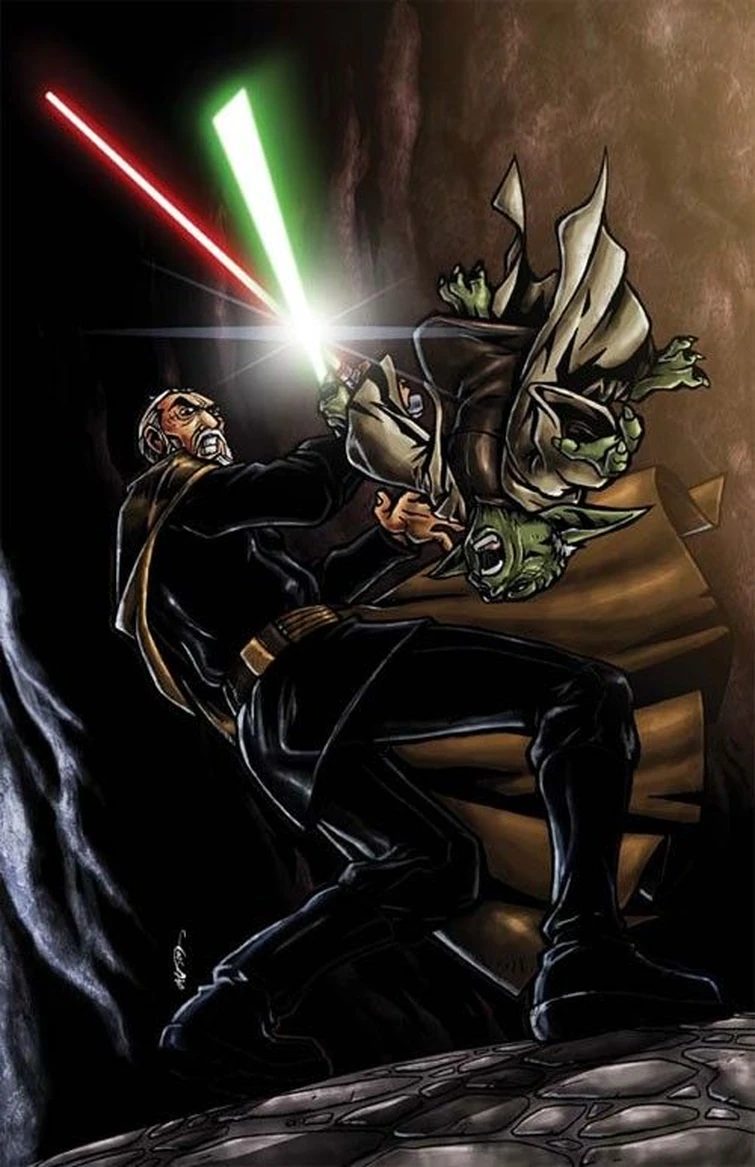
“[…] Instantly he was in the air himself, spinning away from Dooku’s vicious attack before he was even consciously aware it was coming. The blinding scarlet blur of Dooku’s lightsaber split the air, slashing a burning line along Yoda’s side before chopping his desk in half. Yoda whipped out his blade while trying to set Whirry gently down on the cobblestones below.
- Yoda: “Wish to hurt you, I do not!”
- Dooku: “That’s odd. I intent to enjoy killing you.”
- D.: […] “I’ve hurt you!” Dooku cried.
- Y.: “Many times.” Yoda said. He considered his pain: let it drop. No he had nothing but Dooku to focus on, and his lightsaber gleamed with the same fierce green light that flickered from under his heavy-lidded eyes. “But kill me you did not, when you had the chance. A mistake, that was. More than eight hundred years has Yoda survived, through dangers you could not dream.”
- D.: “I know how to kill,” Dooku hissed.
Yoda’s eyes opened wide, like balls of green fire. “Yes – but Yoda knows how to live!”
- Dooku: […] “Yes, feel me. Feel the treason. All those years of teaching me, raising me. Trusting me. And here am I, the favored son, butchering your precious Jedi, one by one. Hate me Yoda. You know you want to.”
- Yoda: […] “And yet, even here on Vjun, where the dark side whispers and whispers to me… love you enough to destroy you I do. […] A choice made, have you, Count?”
- Dooku: “I notice I am no longer you apprentice. There was always a chance you could overpower me, of course. So I put a missile in high orbit, slaved to this location. It’s falling now. Gathering speed. Can you feel it dropping? A thorn, a needle, an arrow. Faster all the time. Obi-Wan and your precious Skywalker and your little Padawans will be wiped out when the missile hits. So what you need to decide is, what means more to you, Master Yoda? Saving their lives – or taking mine?”
(Stewart Sean, 2004, Star Wars: Yoda: Dark Rendezvous, pgs. 315-317).
A major flaw could this be? Perhaps. A fatal one? Not necessarily. Because it is thanks to Yoda’s amazing will to power, burning as bright as a star, that allows him the power to be able to go on, to keep up, to persevere; to live, to just be. That’s why when he responds to Dooku “he knows how to live,” not only that foreshadows, as also serves as an explanation, on why he “ran away” from his “stalemate” duel with Sidious. Not simply because of fear or cowardice (even though Sidious’ dark side aura was growing so intense that, ultimately, it could end up overpowering him), but because his inherent will to power would always pull him towards the light, to life. Trying to bring Sidious down with him to the grave could hypothetically put an end to Palpatine’s stillborn empire. But then, Yoda would have succumbed to Sidious’ will to power (the metaphor of tragedy would fit like a silk glove though), and remember: he didn’t say he knew how to kill, but how to live. Which in turn might just be the best argument to explain why Yoda may be the best character to exemplify the concept of “amor fati.”
>>>>>>>>>>>>>>>>>>>>>>>>>>>>>>>>Continues->>>>>>>>>>>>>>>>>>>>>>>>>>>>>>>>>>


![🤣[Meme Of The Week Contest] Round 262 | Fandom](data:image/gif;base64,R0lGODlhAQABAIAAAAAAAP///yH5BAEAAAAALAAAAAABAAEAAAIBRAA7)