
Hello and welcome to this week's installment of Cue by Cue.
Today we're going to be listening to 6m3 This Is Not A Cave. I'm really excited to talk about this one, this might be the most publicly documented cue in the entire saga.
The BBC aired a documentary in Britain in May 1980 called "Star Wars: Music by John Williams". This documentary dedicates a large portion of its runtime to showing off behind the scenes footage of this cue in particular at various stages of the scoring process. Some of this footage was also later reused in other documentaries and bonus features.
I acquired all of the behind the scenes footage of this cue that I could find, in the highest quality that I could find it, and have reordered the footage to match the actual order of the scoring process. Additionally, I did my best to remove the narration voice where possible, sometimes this was done by switching to a different documentary source that didn't have the narration, and sometimes this was done using AI. In a handful of cases, no narration-less audio existed and AI isolation wasn't possible due to overlapping voices or poor quality artifacting in the case of the orchestra sessions footage. In these cases I left the original narration intact.
This cue is 95 bars long, and was orchestrated by Herbert Spencer.
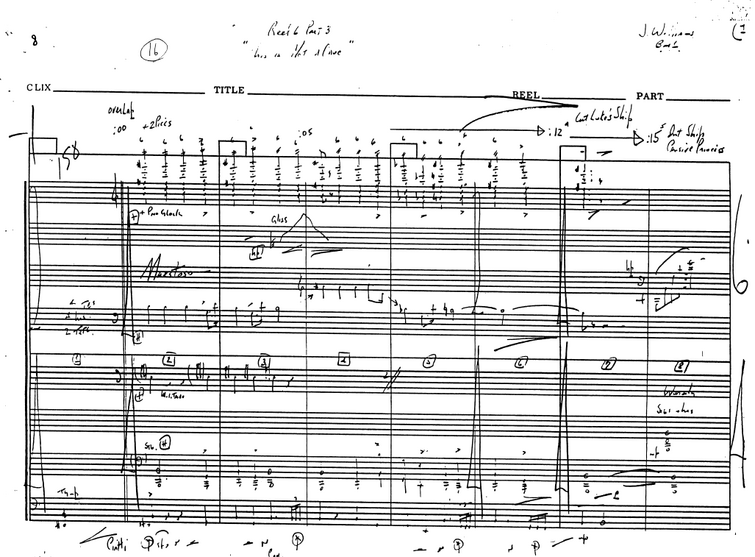
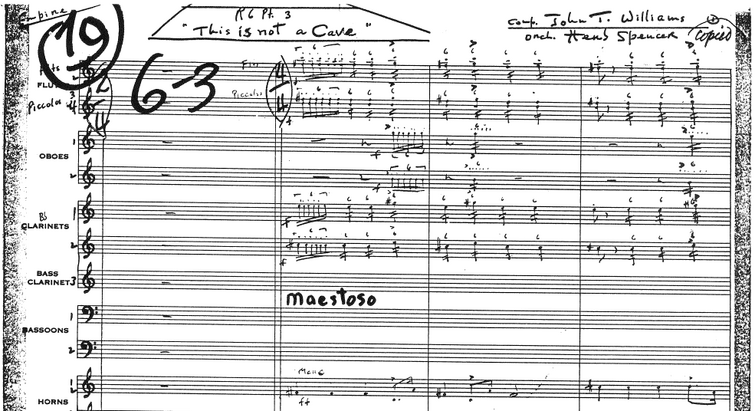
Here's what the tops of the sketch and orchestrated score look like:
Now let's listen to the cue together:

At 0:00 the cue begins with a short rendition of the Imperial March as we witness a Star Destroyer shooting asteroids and some TIE Bombers dropping ion bombs on the big asteroid that the Falcon is in.
Then at 0:14, some soft pensive strings for Leia sitting in the cockpit alone. Mysterious woodwinds at 0:27 for the brief creature sighting, followed by extended piccolo at 0:38 for the longer sighting, which leads into some pulsing action fanfare as Leia runs to get Han.
The fanfare fizzles out around 0:57 as everyone runs out of the ship. More mysterious strings and woodwinds as they walk around outside the Falcon, until the big piccolo comes back at 1:38 for another sighting where Han shoots it.
More mysterious music as Han walks up to it, and then some extended piccolo and brass for the massive Mynock sighting at 1:57.
The pulsing action fanfare returns at 2:20 once the cave starts shaking after Han shoots it. This continues as the heroes run back into the ship and towards the cockpit.
A brass line for the POV shot at 2:58, which builds as the Falcon takes off, climaxing as it flies through the teeth, leading into an extended brass section at 3:10 as the space slug rises up out of its hole and tries to bite the Falcon. This builds into an ascending brass fanfare as the Falcon flies off. Thus, the cue ends...
This cue went partially unused in the final cut. There appear to have been no picture edits made to the scene, however the filmmakers evidently didn't like the first half of this cue because they dropped it from the film.
The following changes were made in the final cut:
0:00-0:05 = 1m2 New Start 0:55-end
0:05-1:05 = silence
1:05-end = 6m3 This Is Not A Cave
The Special Edition is mostly the same, however it removes the tracked bit of 1m2 New Start from the beginning, instead replacing the entirety of 0:00-1:05 with silence.
The BBC documentary I mentioned earlier showed off footage of several stages of the scoring process.
In our first behind the scenes clip, John Williams reviews the rough cut on a Moviola with music editor Ken Wannberg, and consults the detailed timing notes, in order to decide at what points to place sync notes. This is different from the earlier spotting session, where he would've watched the rough cut with the director and producers in order to get a general sense of what scenes required music and what emotions they should convey. Instead, this viewing is much more technical, focused entirely on sync points and timing.
Apologies, the first half has some narration that I couldn't get rid of because it overlaps with some of their discussion. It doesn't cover anything terribly important, they're mostly just discussing timestamps and where to pause.

After the timing notes were taken, Williams went back to his studio and actually began sketching out the cue on a sketchpad, using his piano for reference.
In our second behind the scenes clip, we get to watch him write out the bottom of page 5 and the start of page 6 of the sketch. The original documentary had narration over this entire clip but thankfully I was able to remove it all with AI.

It's extremely cool to see him write out page 6 at 0:12, and be able to compare it to the actual scan:
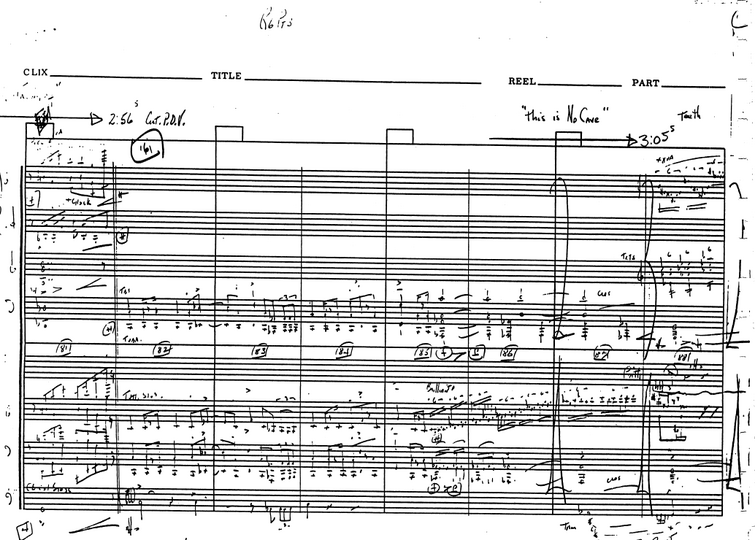
The notes he plays on piano correspond to the brass line at 2:49, though Williams plays it on the piano at a much faster tempo.
After writing out the sketch, Williams went back to Ken Wannberg to double check the timing against the picture. Once again unfortunately the first half of this clip has narration that I couldn't get rid of because it overlaps with their discussion, although the second half I was able to get clean by using another footage source:

While Williams continued working on the sketch, it seems that Herbert Spencer was hard at work in a different room orchestrating a different cue (6m5-7m1 The Magic Tree), which we'll talk more about in a couple weeks. While Spencer is orchestrating, you can hear Williams in the background continuing to come up with parts of 6m3 This Is Not A Cave using his piano. This clip is interesting because it seems to imply that Herbert Spencer and John Williams worked out of the same studio. I'm curious if any of the other orchestrators ever worked there or if they worked independently. Unfortunately this clip has some more unremovable narration in the second half but I was able to get rid of the narration over the first half, which is the part with the Williams piano playing:

After the sketch was finally complete, John Williams had a meeting with orchestrator Herbert Spencer to outline his ideas for the orchestration, and to clarify any points that might not have been obvious from the sketch. This clip I was able to find another source of without any narration, and I'm extremely glad I was because it provides a fascinating look at what these orchestrator meetings looked like. I'm curious if he had one on one meetings like this with all the orchestrators, or if Herbert Spencer as the lead relayed the information to the others. This clip also gives us more footage of John Williams demoing the cue on piano:
Finally, the orchestrated cue was ready for recording at Anvil Studios, where it was recorded in mid-January, 1980. I'm unsure exactly what date it was recorded unfortunately. I'm also unsure how many takes were recorded, but according to the sketch the performance edit uses takes 156, 157, 158, 161, 162, and 163.
The BBC documentary shows 5 minutes of footage of Williams adjusting parts of the orchestra as well as the start of the recording of take 157. I was able to remove some of the narration here but not all of it, in particular there was one section of narration over some conversation that I didn't want to get rid of, and the narration over the orchestra playing couldn't be removed without severe artifacts. Fortunately, most of the footage of Williams talking to the orchestra is narration-free:

Other things you can see in this clip; the special black and white print with the streamers and punches - those are the moving white lines and flashing circles that indicate sync marks to the conductor. You can see how Williams refines every section of the orchestra at specific bars where necessary, and how new takes are made once the podium changes are approved. You can see how Williams asks Lionel Newman for his opinion constantly, and you can see Eric Tomlinson at the mixing table, as well as several people in attendance including George Lucas, Irvin Kershner, and Ken Wannberg. Additionally, this footage mostly shows off the first half of the cue which was dropped from the final film.
This cue has been officially released on four different albums:
1) In 1980 on RSO Records' OST album
3) In 1997 on RCA Victor's 2-CD Special Edition set
4) In 2018 on Walt Disney Records' Remastered album (remastered OST rebuilt from scratch from the session masters)
More specifically, 6m3 This Is Not A Cave can be heard:
From 3:30-end of track 1 "Star Wars (Main Theme)" on the 1980/2018 albums
From 2:11-end of disc 1 track 10 "Jedi Master Revealed/Mynock Cave" on the 1997 album.
All albums have the clean ending, but none have the clean opening. The 1997 release is the only one with the film mix, every other set is remixed.
The 1980 and 2018 releases are both severely cutdown:
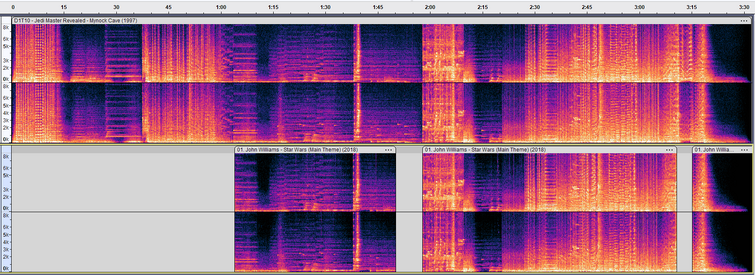
As you can see, the sections from 0:00-1:04, 1:50-1:58, and 3:12-3:15 were excised from the 1980 and 2018 sets, being first premiered in 1997. This is despite the BBC sessions footage mostly demonstrating the first third of the cue, which makes it the first of what will become a long tradition of Star Wars music documentaries showing sessions footage of otherwise unreleased music.
Additionally, most releases of this cue play at the wrong pitch/speed, although this can easily be corrected in an audio editor:
1980: has to be slowed down by -0.300 to match film
1997: has to be sped up by 0.490 to match film
2018: has to be slowed down by -0.900 to match film
For the edit above I used a speed corrected 1997 set, and I used an AI tool to isolate the clean opening - I think this came out almost perfectly, I don't hear any artifacts at all, it sounds just like the natural clean opening heard in the documentary. I didn't use the documentary as a source for this because it's both the wrong take and also the documentary sources all have relatively poor quality audio.
Speaking of which, for the documentary clips I used the following sources:
- the JW Rinzler Making of Empire Strikes Back ebook which had a couple minutes of excerpts in the high quality without any narration
- 16mm scan excerpts from the documentary posted directly to the BBC website: https://www.bbc.co.uk/webarchive/https%3A%2F%2Fwww.bbc.co.uk%2Farchive%2Fjohn_williams_star_wars%2Fzfxvnrd

- a VHS bootleg recording for any clips that couldn't be sourced from the two sources above.
One other note on these sources: both the BBC site video and the VHS bootleg were PAL conformed and were obviously the wrong speed, I used ffmpeg to correct the PAL speedup by converting them from 25fps to 23.976fps and adjusting the sample rate to undo the speed and pitch change.
I did also consult other sources with footage, like the Michel Parbot Making of documentary, but that just reuses clips from the BBC doc in poorer quality. It does have some of the music recording without narration, but the audio sounds so bad that I didn't use it.
That's all I have for today, thanks for reading! Feel free to leave any comments or questions.
Next week we'll be listening to 6m4 Training a Jedi, the only completely unused cue in this score (not counting inserts). See you then!