
Hello and welcome to the next chapter of Cue by Cue.
Today we will begin talking about the next film in the series, Star Wars Episode V: The Empire Strikes Back (1980).
First, a bit of background:
The original Star Wars premiered on May 25, 1977 and was an immediate hit, becoming the biggest film of the year and spawning a decade-spanning franchise that is still popular today.
While the film was widely celebrated for its many achievements, one of the most recognized was John Williams' score for the film. Not only did the OST album sell a record setting number of units, but he won several awards for the film including:
Best Original Score at the 1978 Oscars
Original Film Music at the 1978 BAFTA Awards
Best Original Score – Motion Picture at the 1978 Golden Globes
Best Score Soundtrack for Visual Media at the 1978 Grammys
Best Music at the 1978 Saturn Awards
Here's the video of him winning Best Original Score at the Oscars: https://www.youtube.com/watch?v=zaJTETd_grg
All of this unexpected success led to an increased focus on music for the sequel.
While the original film had 88 minutes of original score, the sequel was planned to have 107, an increase of almost 20 minutes despite the films being similar lengths.
Music talks also began earlier in the post production process: For Star Wars, the spotting sessions weren't until mid-January with recording in mid-March, only two months before release. For Empire, the spotting sessions began in early November, with recording sessions slated for December.
This might be a bit surprising that they would move the timetable up like that, especially given how much the original film had changed visually between recording in March and release in May. Surely earlier scoring for Empire would mean more picture edits and more revisions right?
As we'll come to see over the coming weeks, somehow this actually wasn't the case - Empire appears to have had a much smoother post production than Star Wars, because despite being scored so much earlier it actually had less picture edits. There are still lots of music edits which we'll talk about in the coming weeks, but most of them were not driven by picture changes.
There's a funny anecdote in Alan Arnold's making of journal where he visited Irvin Kershner at Gary Kurtz's house on November 2nd, 1979 - where he found him through Kurtz's record collection in order to find music to lay in the temp track before the spotting sessions began the next day.
Why the temp track was done so last minute is unclear - Kershner says he's primarily doing one to better communicate where he wants music - a markedly different purpose from the original film's temp track which was already there during editing to help the editors pace scenes.
The ESB temp track isn't nearly as well documented as the one for the original, but Arnold did mention records Kershner rejected included sections of Stravinsky, Shostakovich, Hindemith, Copland, Prokofiev and Bliss.
The spotting sessions began the next day on November 3, 1979. I'm unsure exactly how long they went on but they covered at least a couple of days based on the dates on the excerpts of notes shown in JW Rinzler's making of book:
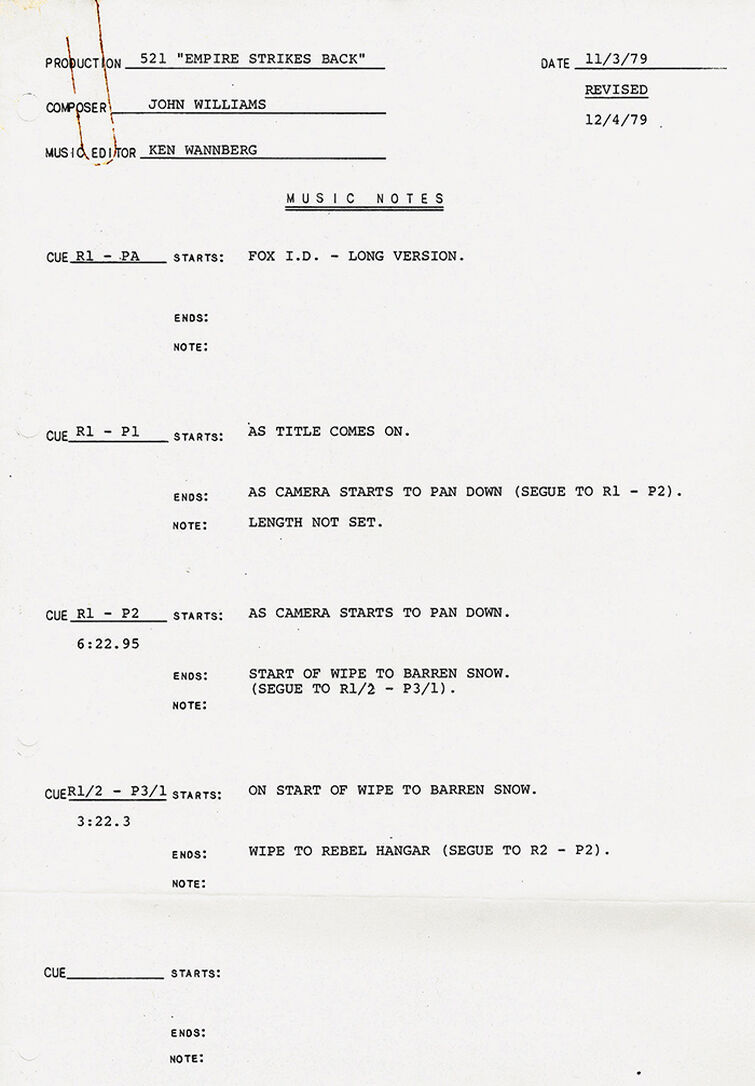
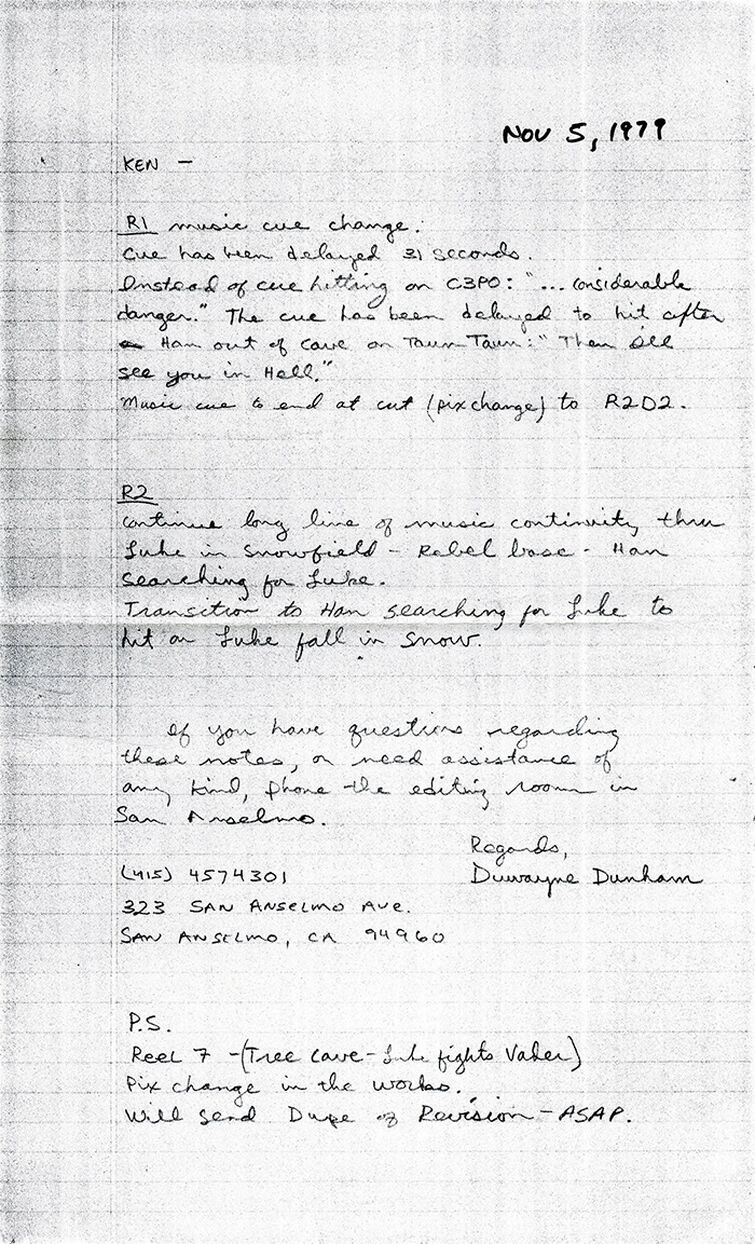
Beyond just the notes excerpts, there are also videos filmed of the actual spotting sessions themselves. The video footage available to the public comes from two primary sources: the enhanced ebook edition of JW Rinzler's making of book, and the 1980 BBC documentary "Star Wars Music by John Williams.
For this score overview I think photos are sufficient, but I plan to include the spotting footage in the relevant cue entries when I get to them.

In this photo from JW Rinzler's book from left to right you can see music editor Ken Wannberg, music supervisor Lionel Newman, composer John Williams, and director Irvin Kershner. Unfortunately I don't know which day this photo is from, it's undated in the book and Wannberg's notes are far too washed out and low resolution to read.
It's unfortunate that Alan Arnold wasn't actually present at the spotting sessions, his journal skips right over them. He did interview John Williams a week or two after they ended though, the last entry of his book is a November 17th interview with Williams at his house where the amount of music in the film has already been set at 107 minutes and Williams is in the middle of writing the score.
Writing followed the exact same process as on the first film, Williams wrote cues onto 8 line sketchpad which was then handed off to the orchestration team to be hand-copied into full scores.
The orchestration team changed a bit from 1977 - for Empire, the full team became:
- Herbert Spencer
- Angela Morley
- Al Woodbury
- Fred Steiner
Three of the four had previously worked on Star Wars, so technically the only new face was Fred Steiner; however, Al Woodbury and especially Angela Morley did far more work on the sequel than they had on the original. Arthur Morton did not return for Empire.
Unlike the original film, Empire did not undergo picture edits during the months of November-December that would have required rescoring, so no revisions were written before the recording sessions. When replacement music was requested at the sessions, the new music would be drafted up as an insert rather than a complete revision.
Another consequence of this is that the cue number shuffling ("rebalancing") that plagued large parts of the original score is completely non-existent for Empire.
Williams had about 7 weeks to write the score between early November and late December.
The recording sessions were held on December 27-29 of 1979, as well as January 7-10 and 17-18 of 1980.
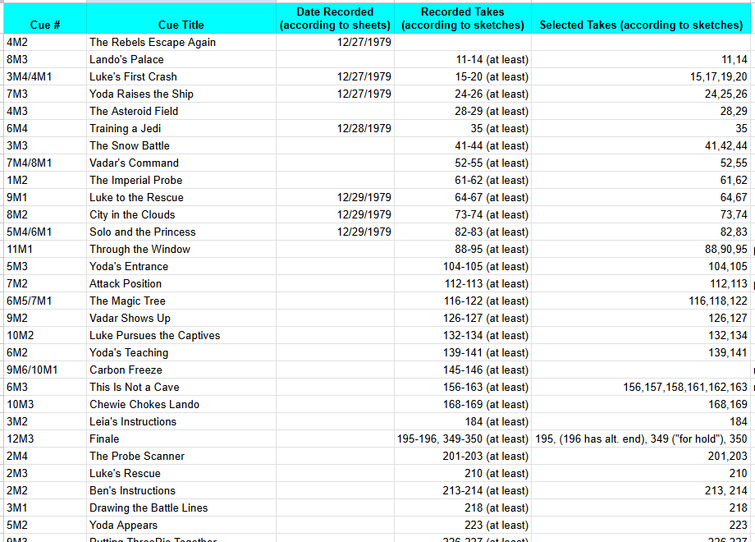
Unfortunately the 1997 ESB album did not come with a recording log like the original film's had, so I can't provide a comprehensive breakdown of takes and recording dates like I did for the first score. That said - I was able to reconstruct some of this information from other sources - mostly the circled takes in the sketch scans I have. Thanks to these I can at least provide an approximate order in which cues were recorded and roughly what takes covered them (full breakdown is in my spreadsheet linked later):
Unlike Star Wars, some of the recording sessions for Empire actually got filmed, footage from them is used in several Star Wars documentaries including the BBC music documentary mentioned earlier as well as the Michel Parbot making of documentary. I will show some of this sessions footage in the individual cue entries when relevant.
Just like the original score, Empire was recorded in the now-defunct Anvil Studios in Denham England, with the London Symphony Orchestra. Empire was actually the last score ever recorded there, Anvil Studios shut down shortly afterward and the building was demolished.
Thanks to the original vinyl liner notes, here's a complete credit list of every musician who played in the Empire sessions:
1st Violins:
Michael Davis
Irvine Arditti
Lennox Mackenzie
Nigel Broadbent
Stanley Castle
Robert Clark
Sidney Colter
Dennis Gaines
Colin Renwick
Robert Retallick
Cyril Reuben
Norman Clarke
Brian Gaulton
David Llewellyn
Brian Smith
Paul Willey
2nd Violons:
Warwick Hill
Neil Watson
Sam Artis
William Brown
Thomas Cook
Geoffrey Creese
Terry Morton
Jack Steadman
Donald Stewart
Thomas Swift
David Williams
David Goodall
Alan Merrick
Edward Barry
David Ellis
Nicholas Maxted-Jones
John Ford
Violas:
Alexander Taylor
Brian Clarke
Peter Noriss
Patrick Hooley
Michael Mitchell
William Sumpton
David Hume
Patrick Vermont
Richard Holttum
William Krasnik
Eric Cuthbertson
Roger Welch
Cellos:
Douglas Cummings
Rod McGrath
Ray Adams
Maurice Meulien
Clive Gillinson
Kenneth Law
David Powrie
Francis Saunders
Paul Kegg
Jack Long
Martin Robinson
Nigel Pinkett
Basses:
Bruce Mollison
Paul Marrion
Arthur Griffiths
John Cooper
Gerald Newson
Pashanko Dimitroff
John Hill
Simon Hetherington
Robin McGee
Flutes:
Peter Lloyd
Richard Taylor
Lowry Sanders
Francis Nolan
Oboes:
Anthony Camdren
Roger Lord
John Lawley
Geoffrey Browne
Michael Jeans
Clarinets:
Jack Brymer
Roy Jowitt
Ronald Moore
John Stenhouse
Ted Planas
Bassoons:
Martin Gatt
Robert Bourton
Peter Francis
Nicholas Hunka
John Orford
Horns:
David Cripps
Anthony Chidell
James Brown
James Quaife
Graham Warren
Jeffrey Bryant
John Rooke
Terry Johns
Denzil Floyd
Trumpets:
Maurice Murphy
William Lang
Malcolm Hall
Norman Archibald
James Watson
Ralph Izen
Ian Macintosh
Stanley Woods
Gerry Ruddock
Trombones:
Denis Wick
Eric Crees
Roger Groves
Frank Mathison
Arthur Wilson
Roger Brenner
Tuba:
John Fletcher
James Anderson
Patrick Harrild
Timpani:
Kurtahans Goedicke
Percussion:
Michael Frye
Ray Northcott
Russell Jordan
Jack Lees, David Johnson
Keith Millar
Stephen Henderson
Harps:
Renata Scheffelstein
Clifford Lantaff
Nuaia Herbert
Thelma Owen
Piano/celeste/electric piano:
Robert Noble
Michael Reeves
Leslie Pearson
Synthesizer:
Francis Monkman
Ann Odell
Brian Gascgoine
You might notice the Synthesizer category which was not here in the original score. That's one of the few instrumentation changes made for Empire other than just having a slightly larger orchestra, cues have synth now. It is used pretty sparingly, only five cues use it in the entire score, but it is present where it wasn't before.
Just like the first score, the sessions were overseen by Lionel Newman from the 20th Century Fox Music Department. The sessions were again recorded by engineer Eric Tomlinson, and his assistant Alan Snelling. This time the upgraded mixing console allowed them to record 24 simultaneous channels onto 24-track tape. A live LCR mix was done onto 8-track tape, with the first 3 channels for the actual LCR, the next 3 for ambient pickup, an empty 7th channel to prevent crosstalk and an 8th with a 50 hz tone for syncing purposes.
Just like the original score the LSO did not practice the music ahead of time, everything was sight-read and multiple takes were used in order to provide options to correct any performance errors.
Performance edits were made of the 24 track and 8 track tapes directly onto the masters (AKA they were cut with a knife and taped together). The 35mm magnetic film was made from the edited 8-tracks, so it only contained the intended takes. This differed from the process used on the original Star Wars, where the 35mm included every take recorded.
The 35mm was then used for dubbing into the film, where further music edits were done by Ken Wannberg at the request of the director.
The commercial soundtrack was sequenced by John Williams and remixed by John Neal from the 24-track masters. The original film mixes would not be released until the Anthology set came out in 1993.
Unlike the original Star Wars where every album other than the original uses the film mixes, for Empire most of the album releases are actually remixes from the 24-tracks. The only releases to include the original film mixes are the 1993 album and some of the tracks on the 1997 album.
The releases of this score are a little confusing. Evidently the master tapes were not well taken care of - the 1993 and 1997 sets both had to come from several sources.
For example, the 1993 set is mostly made from poor condition 1/4" backup tapes (which disintegrated while being transferred), but they were incomplete, so some cues had to be sourced directly from the film stems or from the remixed OST master.
As for the 1997 set, about half of the cues came from the same transfers used in 1993, and the other half came from new transfers of incomplete 24-track masters which were newly discovered, and were remixed by Brian Risner. These Brian Risner remixes are notorious for having a narrow stereo image and for sounding nothing like the film - but in his defense, he was apparently given only 6 hours to do the remix!
There's not much documentation on what sources were used for the 2018 remaster, but it's also pretty clearly a remix because it sounds really bad. Where the 1997 remixes are center-heavy, the 2018 remixes are left heavy and sound nothing like the film or any previous release. There is evidence that the 24-tracks were re-transferred for this set, thanks to a The Star Wars Show segment promoting the Remasters back in 2020:
https://www.youtube.com/watch?v=4NgPKSzR0LU&t=331


I will go over which cue uses which mix in more detail with the individual entries in the coming weeks.
One other interesting point to note is that some Empire Strikes Back master tapes ended up getting sold on ebay back in 2014 (more evidence of how well Lucasfilm took care of their archives 😔). These master tapes had come from the John Neal estate, and had been traded between collectors. It's unclear whether these include some of the masters that were missing when the 90s ESB set was produced, but Lukas Kendall has claimed that they had been digitized by LFL as of 2014.
It is confirmed that these included some of the masters that were missing from the original film in 1997 - that's one of the main reasons the 1997 ANH set uses the 35mm film mixes instead of the 16-track tapes, the 16-track tapes were destructively edited by John Neal and the only scraps in the Lucasfilm archives were that which were not used for the film, the stuff that was used was in John Neal's possession.
For more information about soundtrack restoration in general I highly recommend watching the Chris Malone episode of Star Wars Music Minute:
https://www.youtube.com/watch?v=DVwqsZ9Wv60

I have a spreadsheet breaking down where you can listen to each cue in the score, but I will also list this information in more detail at the end of each cue's weekly post. The spreadsheet primarily just focuses on where music can be heard, it doesn't mention anything about the remixes:
 Enderdrag64's The Empire Strikes Back Comparison (created from template by Jason LeBlanc)Google Docs
The Empire Strikes Back is an interesting score because it doesn't just replicate the original. Like the film itself, it goes out of its way to be new and different, and not just to rehash the first one.
Out of the major themes in the first movie:
Luke's Theme/Star Wars Theme
Ben's Theme/The Force Theme
Leia's Theme
Rebel Fanfare
Imperial Motif
Death Star Theme
In ESB the Imperial Motif and the Death Star Theme don't return at all, and Leia's Theme and the Rebel Fanfare get massively sidelined.
In their place, we get a boatload of new themes:
The Imperial March
Han and Leia's Love Theme
Yoda's Theme
Droid Motif
Lando's Theme
Boba Fett Motif
These are combined with the returning themes from the first film to create a score that's even more thematic than the original.
I'm super excited to start writing this series. The Empire Strikes Back is my favorite Original Trilogy score, and is a contender for my favorite score of all time.
Further Reading:
People asked the last time I did one of these if I could provide some sources so here's a list of resources to check out if you want to learn more, I did link some of these above already.
1980 vinyl liner notes
1993 Anthology CD liner notes
1997 Special Edition CD liner notes
JW Rinzler's Making of The Empire Strikes Back
Enhanced ebook videos for JW Rinzler's Making of The Empire Strikes Back
Alan Arnold's Once Upon a Galaxy - A Journal of the Making of the Empire Strikes Back
BBC Documentary: Star Wars Music by John Williams
Michel Parbot Making of The Empire Strikes Back documentary
SPFX: The Empire Strikes Back documentary
Sketches + Conductor's score
January 1994 FSM issue: https://www.filmscoremonthly.com/backissues/viewissue.cfm?issueID=151
January 1997 FSM issue: https://www.filmscoremonthly.com/backissues/viewissue.cfm?issueID=10
Chris Malone's Recording the Star Wars Saga pdf: https://www.malonedigital.com/starwars.pdf
Chris Malone interview on Star Wars Music Minute: https://www.youtube.com/watch?v=DVwqsZ9Wv60
The Star Wars Show 2018 Remasters promotional segment: https://youtu.be/4NgPKSzR0LU?t=234
JWFan thread about master tapes being on ebay: https://www.jwfan.com/forums/index.php?%2Ftopic%2F24113-some-john-williams-master-tapes-are-on-ebay-right-now%2F=
FSM thread about master tapes being on ebay: https://filmscoremonthly.com/board/posts.cfm?forumID=1&pageID=1&threadID=101432&archive=0
“Williams closeted in a sci-fi setting as Pops ‘secret’ unfolds” - Boston Globe article by Richard Dyer, 1/10/1980
Frank Lehman's thematic document: https://franklehman.com/starwars/
That's all I have for this week, thanks for reading! Feel free to leave any comments or questions.
I can't wait to get into the score for real next week with our first cue: 1m1 Main Title
