
Hello again, welcome to this week's installment of Cue by Cue.
Today we begin with the first score in the Star Wars saga: Star Wars (1977)
This installment I'm going to give a brief overview to the entire score, and then starting next week we'll finally begin looking at each cue one by one.
First for some background:
John Williams was hired to write music for Star Wars on the recommendation of Geroge Lucas' friend Steven Spielberg, who he'd had just two previous collaborations with (The Sugarland Express and Jaws).
I think a lot of people don't realize, John Williams was not the famous composing legend that he is today - in 1976 he had written almost nothing that he would later become known for. Barring the two Spielberg scores I've mentioned, he'd only really worked on some tv stuff and some weird comedies in the 60s, as well as a few disaster movies in the early 70s. It wouldn't be until after his success with Jaws and Star Wars that he became a household name and started taking higher profile projects.
John Williams was first talked to about the project in late 1976. Different sources disagree on the exact details, Williams has claimed that George Lucas originally intended to just use classical music in a similar vein to 2001 A Space Odyssey, and that Williams talked him into the need for an original score; but George Lucas has disputed this, saying he always intended to have an original score in a classical style.
I've seen some people speculate that perhaps Williams was originally brought in only for the cantina music as implied by the liner notes, or maybe instead Williams was hired to do a score highly derivative of the classical pieces and that he simply convinced Lucas that the score should be *more* original.
Regardless of the exact details, what is known for certain is that George Lucas had picked out a selection of classical pieces for the temp track which was used while the film was being edited. Many of these have been revealed by editor Paul Hirsch and sound effects designer Ben Burtt in various interviews, although they have sometimes contradicted themselves:
The main title was temped with either the overture to Ivanhoe by Miklós Rózsa (if you believe Hircsh's quote in JW Rinzler's the Making of Star Wars), or Erich Korngold's theme to the 1938 Robin Hood (if you believe Hirsch's own autobiography)
Luke's theme was apparently temped with Anton Bruckner's Ninth Symphony (according to Ben Burtt - confusingly the Main Title crawl is made of Luke's theme, so this may actually be a third claim as to what was used for the title crawl)
Igor Stravinsky's The Rite of Spring (specifically The Sacrifice portion) was used for the droids wandering the desert, and some of the Jawa scenes
Benny Goodman's Avalon (the Carnegie Hall performance) was used for the cantina scenes
A cue from Bernard Herrmann's Psycho score was used for the scene where the heroes exit the hidden compartment of the Falcon.
Igor Stravinsky's The Rite of Spring (this time the Dance of the Adolescents portion) was used again for some of the early battle footage
Max Steiner's score from King Kong (specifically the approach to Kong Island) was used for the approach to the Death Star
Antonín Dvořák's New World Symphony was temped into the medal ceremony
It's also likely that Holsts' Mars The Bringer of War was temped into the first appearance of the Star Destroyer, as well as the part right before the Death Star blows up. (there is no specific firsthand source claiming this, but other than just the obvious similarities in sound, JW did mention Holst by name in the 1977 liner notes)
When John Williams was first brought on, he watched an early cut of the film that had this temp track. This was the spotting session, where he and George Lucas went through the entire film and decided which scenes were deserving of music. This process began on January 10, 1977
Here's the first page of the spotting notes (taken from The Making of Star Wars):
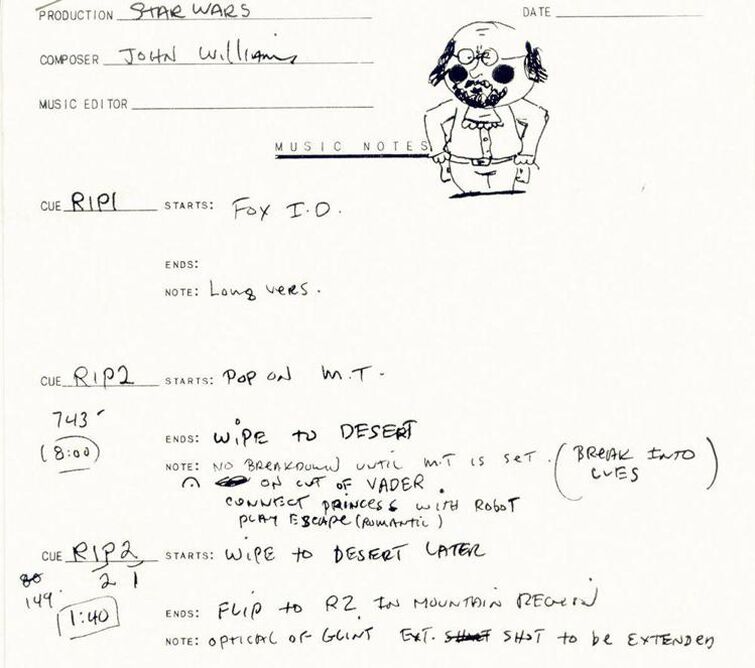
You can see how the notes include the shots a cue would start and end on, as well as notes describing any additional information that JW might have needed to be aware of before he started writing.
After spotting was finished, Williams went to work writing the score, first writing it out on 8-line sketchpad before handing the finished cues off to his orchestration team to hand-copy into a full score format.
Here's a list of the orchestrators who definitely worked on Star Wars:
Herbert Spencer
Arthur Morton
Angela Morley
Al Woodbury
Notably, John Williams has claimed that he himself and also Alexander Courage also orchestrated for the score, but no sheet music that they orchestrated has ever been seen by the public. That being said, there are a handful of cues from this film where orchestrated sheets have not leaked yet, so it's possible that they orchestrated one of those. For now though I would say that their involvement is not definitive.
The film changed a bit in editing between the spotting sessions and the recording sessions, so some of the cues have multiple revisions to account for scene changes - but I'll discuss these in more detail when I start going through each cue one by one.
For now, I will show the handwritten cue list that you can see an excerpt of in The Galaxy That Britain Built documentary:

Unfortunately I don't have a full scan of this, and they didn't show the entire thing in the documentary, but it does give you a glimpse of what the original cue log looked like.
The recording sessions were held on March 5, 8-12, 15-16 of 1977. There is a more exact recording log available on the 1997 album liner notes, which I also transcribed here:

The gap between the spotting and recording sessions means that John Williams had about 7 weeks to finish writing the score between mid January and early March. The score was recorded in the now-defunct Anvil Studios in Denham England, with the London Symphony Orchestra. Here's a complete credit list of every musician who played in the sessions:
1st Violins:
Neville Taweel (Leader)
Richard Studt (Principal)
Irvine Arditti (Principal)
Brian Thomas (Sub-Principal)
Stanley Castle
Sydney Colter
Dennis Gaines
Robert Retallick
Cyril Reuben
Norman Freeman
Max Emil Alwin Weber
Robin Brightman
Brian Gaulton
2nd Violins:
Warwick Hill (Principal)
Neil Watson (Co-Principal)
Samuel Artis
William Paton Brown
Thomas Cook
Terence Morton
Jack William Steadman
Donald A Stewart
Thomas Albert Swift
David Williams
Robert Clark
Geoffrey Creese
David Llewellyn
Violas:
Alexander Taylor (Principal)
Brian Clarke (Co-Principal)
Peter Norriss (Sub-Principal)
Patrick (Paddy) Hooley
Michael (Mitch) Mitchell
David Hume
William Sumpton
Patrick Vermont
William Krasnik
Eric Cuthbertson
Cellos:
Douglas Cummings (Principal)
Maurice Meulien (Co-Principal)
Raymond Adams (Sub-Principal)
Jack Long
Kenneth Law
Douglas Powrie
Francis Saunders
Clive Gillinson
Tom Storer
Keith Glossop
Basses:
Bruce Mollison (Principal)
Arthur Bowen Griffiths (Sub-Principal)
John Cooper
Gerald Newson
Pashanko Dimitroff
Gordon Neal
Flutes:
Richard Mervyn Taylor (Principal)
Lowry Sanders
Francis Nolan
Oboes:
Roger Lord (Principal)
Anthony Camden (Principal)
Clarinets:
Jack Brymer (Principal)
Ronald Moore
Roy Jowitt
Bassoons:
Robert Bourton (Principal)
Peter Francis
Horns:
David Cripps (Principal)
John Rooke (Asst. Principal)
Anthony Chidell
Graham Warren
James Quaife
James Brown
Steve Reading (freelance)
John Butterworth (freelance)
Trumpets:
Maurice Harrison Murphy (Principal)
William Lang
Norman Archibald
Ralph Izen (freelance)
Trombones:
Denis Wick (Principal)
Eric Crees (Princiapl)
Frank Mathison
Tuba:
John Fletcher (Principal)
Steve Wick (freelance)
Timpani:
Kurt-Hans Goedicke (Principal)
Percussion:
Michael Frye (Principal)
Ray Northcott
Harp:
Renata Scheffel-Stein (Principal)
John Marson
Piano/Celeste:
Robert Noble (Principal)
Michael Round (freelance)
The sessions were overseen by Lionel Newman, who was from the 20th Century Fox Music Department. The sessions were recorded by engineer Eric Tomlinson, and his assistant Alan Snelling. They recorded with 16 different microphones, recorded directly to a 16-track master tape, simultaneously recorded with a live LCR mixdown onto 3-track masters. These live mixes are what ended up being used in the film.
The LSO was not given the music to practice with ahead of time, they sight-read everything that they played. Each cue usually had a handful of takes recorded before moving on to the next one, and the takes would later be spliced together into a final performance edit by music editor Ken Wannberg.
Ken Wannberg was also responsible for editing the music into the final film, and we'll get more into some of the edits he did when we talk about each cue one by one.
The last step of the music process was releasing it commercially. As is traditional with soundtrack albums, the OST for Star Wars was not complete, it only contained a selection of cues in a random order and with various edits made to them. Supposedly these changes are made for "listening experience" purposes, although I personally feel they generally make the experience worse.
For its OST album, the film mixes weren't used, but rather the score was remixed from the 16-track multitracks by remixing engineer John Neal. The original mixes wouldn't be released until the 1993 Anthology edition boxset. Every release after the original OST uses the original film mixes.
Jay of jwfan.com did a spreadsheet breakdown of the various releases of this score available here:
https://docs.google.com/spreadsheets/d/1NTJGw3zWk6qamNFBPNCfrQiMefuO2BQCDlovHwi6ud4/edit#gid=0
I do also plan on talking about where you can listen to each cue as I go through them one by one.
Now that the background is out of the way, here are some of my thoughts:
It's interesting to look back on this score with the context of everything that's come after it: for one thing it's very short - the entire score is just barely over 90 minutes long, and that's including alternates and concert suites.
It's also interesting how few themes there actually are. This first score only has:
Luke's Theme/Star Wars Theme
Ben's Theme/The Force Theme
Leia's Theme
Rebel Fanfare
Imperial Motif
Death Star Theme
Jawa Theme
And that's really it. Only 7 themes, and the Death Star theme is only really used for scene transitions, and the Jawa theme appears in a total of 2 cues. So really there are only 5 main themes in this score. It's really quite simple when you lay it out like this, especially compared to its sequels.
That's all I have for this week, I'm super excited to start breaking the score down for real next week, with our first cue: 1m2 Star Wars
