


Today, with the arrival of Kenobi just over the horizon, I thought it might be fitting to do a historical exposé on the beloved Jedi Knight who fought in the Clone Wars, fell in love with a Mandalorian, battled his brother as his Order was annihilated and helped to raise and protect the young lad who would one day go on to free the galaxy from darkness: Luke Skywalker. A tale of triumph and tragedy, courage, and sacrifice, this is the legend of Obi-Wan Kenobi- join me on a brief trip through history as we encounter the many real life figures who (I believe) have shaped both the character’s journey and evolution... Enjoy!
“They come to destroy what I have come to love”- Jules Brunet

We begin in familiar territory: Japan, 1868, at a time when the western powers had torn down the curtain of “Sakoku” with literal “gunboat diplomacy” and ushered in a new era of national exploitation (with “Japanese spirit, Western technology) and political revolution (with the Meiji Restoration). After 250 years of relative peace, the country found itself gearing up for yet another civil war as the Emperor fought the Shogunate for control of the country. With vested interests, the western powers began to take sides, with Britain and America supporting the Emperor while France fell in with the Shogunate. Both sides sent weapons and military experts to supply and train the two armies...

Any of you who followed my Mandalorian Saga will recognise the period of history I’m describing, as well as the name of my first Kenobi counterpart: Jules Brunet.

An experienced soldier and a keen artist, Brunet was part of Napoleon III’s 1867 expedition to Japan before he ended up fighting with the Shogun and, in turn, inspiring the character of Nathan Algren - the traumatised Indian War veteran (played by Tom Cruise) who joins the samurai rebels under Katsumoto in the 2003 epic war film: The Last Samurai.

Like Brunet, Algren fell in love with the country he was serving in and with the way of life of the people who lived in it, turning against his barbaric mother country and following his heart to learn of values such as honour, courage and sacrifice. When the Boshin War broke out and his French commanders left to return to the Fatherland (having fulfilled their mandate), Brunet disobeyed orders along with several others and stayed behind to fight for the heavily outclassed Shogunate forces. Algren did likewise, filled with disgust for the greedy bureaucrats infecting the country and admiration for his samurai brethren’s lost cause. As Katsumoto sought to die in battle, Algren adopted the samurai way of life, fighting in the samurai style, using samurai tactics and wearing samurai armour into battle. In short, by the end of the movie, he is more samurai than American. He becomes a true native...

Now, what do these two men have in common with Kenobi? Well, like Algren, Obi-Wan fell in love with the daughter of a warrior race: Satine Kryze, Duchess of Mandalore. As with Algren, he was caught up in one of the country’s many civil wars, forced to protect the woman he loved from power-hungry warlords. Slowly, he found himself falling back in love with her and caring for the fates of the people living under her. However, as with Brunet, Kenobi found himself caught between a rock and a hard place: Mandalore had fallen, but the Jedi Council were unwilling to aid a sovereign planet. So, like Brunet and Algren, Obi-Wan disobeyed his superiors and chose to fight for the people who had stolen his heart, using Mandalorian weapons and Mandalorian tactics to combat the enemy. Like Algren, Kenobi would garb himself in Mandalorian armour. And what colour was that armour? Red as well.
THE LAST LIGHTSABER DUEL- Jean de Carrouges

The famous duel between Anakin and Obi-Wan across the lava flats of Mustafar is widely regarded as the definitive lightsabre battle in the Star Wars franchise. Its real life counterpart remains one of the greatest one-on-one battles in all of history (as well as the last judicial duel fought in the Middle Ages): the deadly grudge between the 12th century French knights, Jacques le Gris and Jean de Carrouges (their story most recently dramatized for the big screen in the form of acclaimed director Ridley Scott’s The Last Duel)...
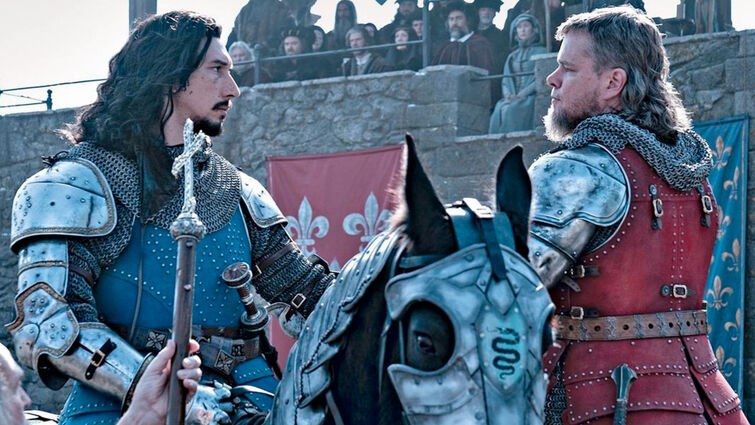
Though the duel itself would be fought over the honour of a woman, the actual grudge between the two knights was originally born out of aristocratic favouritism. Jean de Carrouges had been the heir to a very old and very proud family when he came to the court of Count Pierre d’Alençon, and yet, his younger, less privileged rival, Jacques le Gris, had quickly become the count’s favourite. Jean had lost several of his ancestral plots to the French Court and his chevauchée campaigns against the English in Scotland (medieval Europe was currently in the grip of the Hundred Years War) had proven to be unsuccessful, so when the count transferred the lands of Jean’s bride, Marguerite de Thibouville, over to Jacques, it was the last straw needed to break the friendship between Carrouges and le Gris...

Though the duel between Kenobi and Skywalker would be fought over Anakin’s pledge to the dark side, the initial grudge between student and master likewise involved bureaucratic favouritism. Though there were no hard feelings on Kenobi’s part, the Jedi Order was outraged when Chancellor Palpatine overruled its traditions and had Anakin allotted a seat on the Jedi Council. And, thanks to the memes, we all know how that worked out... “You are on this Council, but we do not grant you the rank of master”- “This is outrageous!”- “Take a seat, young Skywalker”. Anakin soon began to see his old friend as a potential rival...
The feud between Carrouges and le Gris would reach its bitter climax when Jean accused Jacques of forcing himself upon his wife. Owing to the rampant chauvinism of the period, it was agreed that Marguerite’s innocence would be decided with a “trial by combat”. If Jean won, Marguerite would be seen as a wronged woman, but if Jacques won, she would be burned at the stakes for wrongly accusing le Gris. The two knights met at a public arena on the 28th of December 1386, and battle commenced...

As Order 66 saw the Jedi Order wiped out and the Galactic Republic turned into the Galactic Empire, Obi-Wan Kenobi and Anakin Skywalker (now going by the moniker of “Darth Vader”) met upon the plains of Mustafar and an epic lightsaber duel broke out. Both skilled warriors, the two Jedi battled one another through hallways, over bridges and across flowing rivers of scorching lava. Like Carrouges and le Gris, these two brothers-at-arms who had once loved each other as friends, now fought one another as the bitterest of enemies until, finally, Obi-Wan (literally) gained the upper hand and sent Anakin tumbling into the lava...

The duel began with a traditional joust. Carrouges was an experienced warrior but le Gris was much taller and much stronger. Trapping Jean beneath his horse after running the poor beast through with his lance, Jacques moved in to finish his opponent off. However, drawing his longsword, Carrouges turned the tables, disembowelling le Gris’s mount and levelling out the playing field somewhat; now, the duel was on foot. The ensuing melee would last for several minutes as the two knights hammered away at each other. Stabbing Carrouges through the thigh, it looked like le Gris would prevail. However, enamoured by the cheering crowds, the arrogant knight failed to go in for the kill, allowing Carrouges to turn the tables once again and pull his opponent to the floor, where the shear weight of his armour left Jean holding his rival’s life in his hands. Cracking open the man’s faceplate with a dagger, Carrouges ordered le Gris to confess. When the knight refused, Carrouges plunged the dagger into his throat...
Thus ended the feud between Carrouges and le Gris, as well as the last judicial duel fought in medieval Europe. Marguerite’s cause had been proven just and Jean had defended his wife’s honour. On Mustafar, good likewise triumphed over evil, however, unlike the ambitious Jean de Carrouges, poor old Obi-Wan Kenobi had lost far more than he had gained...
EL NEGOCIADOR- Rodrigo de Vivar

If there ever was a perfect Kenobi counterpart, it is (IMO) most definitely the 11th century Castilian knight and nobleman: Rodrigo Díaz de Vivar, better known by the moniker of “El Cid”. Like Obi-Wan, El Cid was one of the greatest knights ever to stride the pages of fiction. That is because, although he was indeed a very real person, Vivar’s epic crusades against the Arabic invaders (during the Reconquista) were told and retold with the epic poem El Cantar de mio Cid, turning his story into something of a Spanish version of King Arthur and transforming the great knight into an enduring symbol of Spanish culture and history...

Born to a family of minor nobility in 1043, Rodrigo would be thrust headfirst into one of the most important religious conflicts in European history: the Reconquista. A skilled swordsman and a talented strategist, he would change sides as the politics of the period changed, fighting firstly against and then alongside the Moors. Serving in the court of King Sancho II, Rodrigo would help to crush numerous internal revolts, earning the favour of his king as well as the admiration of the men who served under him. However, it was not to last...

A wise tactician as well as an experienced lightsaber duellist, Obi-Wan Kenobi would likewise go down in Republic history as one of the greatest Jedi Knights of all time. Combining daring battle plans with compassion for the lives of his troops and a flair for diplomacy, Kenobi would win a string of major victories for the Republic and earn himself the nickname of “The Negotiator” as the Separatist Alliance was slowly defeated. Fighting alongside his beloved blood brother, Anakin, Kenobi would see the mighty Droid Armada defeated at the Battle of Coruscant and the Droid Army rendered leaderless at Utapau. However, as with Rodrigo and good King Alfonso, there was skulduggery afoot...
When Sancho II was brutally assassinated in 1072, he was succeeded by his scheming younger brother, Alfonso. But though Alfonso had succeeded in taking the throne, many in his kingdom believed that he had arranged for his brother’s death, including El Cid. According to legend, when Rodrigo attended Alfonso’s coronation, he forced the new king to swear upon the holy texts that he’d played no part in his brother’s death. Reluctantly, Alfonso did so, clearing his name and earning Rodrigo’s loyalty... temporarily. After leading an unsanctioned campaign against the Taifa of Granada, Rodrigo was exiled from the court of King Alfonso. Wandering the land as a soldier of fortune, Rodrigo would eventually join up with the Moors of Zaragoza and it was during his time in their service that Rodrigo would earn his famous nickname: “El Cid”- “The Master” (or “Lord”). He would help the Moors to conquer territory in Aragon and Iberia while King Alfonso struggled to halt a Berber invasion led by the warlord, Yusuf ibn Tashfin. El Cid would return to save his king from destruction and lead his armies into battle; the old warrior still had one fight left in him...

Order 66 would likewise see everything Kenobi had once loved and served betrayed and destroyed, with the great knight going into exile and living like a hermit while he watched Anakin’s infant son grow from a whiny teenager (just like his dad) into a new hope for the galaxy. Little is known about El Cid’s personal life, other than the fact that he was married to a woman named Jimena who bore him many children. Obi-Wan Kenobi knew no such happiness as he concentrated on raising Luke, but in his early life, The Negotiator did know a love to rival El Cid’s: Satine Kryze. Long ago, Obi-Wan had met and fallen in love with the Duchess of Mandalore, but he had been forced to give her up by the strict teachings of his Order. Though no such drama existed in Rodrigo de Vivar’s real life, it did in the 1961 Charlton Heston epic based on the aforementioned poem. When El Cid is recalled from exile, Jimena begs him not to leave for she knows that he will most certainly be killed. Even though he’d like nothing more than to stay with her for the rest of his life, Rodrigo has to place duty above love, just as Kenobi did with Satine. And so, with El Cid riding off to retake Valencia from the Berbers and Obi-Wan receiving a secret message from the rebellious young princess of Alderaan (Leia Organa) we enter the last phase of this comparison...

When researching the death of El Cid, fiction really is better than fact: trapped within the walls of Valencia by thousands of Berbers, the great knight finally succumbed to old wounds and new diseases. However, El Cantar de mio Cid paints very different, far more glamorous picture: leading his men into the thick of battle, El Cid was mortally wounded. Faced by overwhelming odds, his wife knew that unless her husband personally led his troops to victory, the Berbers would undoubtably take Valencia. So, Jimena dressed her husband’s dead body in his suit of armour and tied him down to his saddle with his lance, sword and shield. Unaware that their leader had already died but still inspired by the mere sight of him, the Spanish troops surged forward and completely overwhelmed the Berber army. However, when they went to congratulate their leader, they found him riding off into the sunset, deaf to their cries of victory. Some say this was the beginning of the legend of El Cid and some say that, even today, you can still hear Rodrigo’s horse, galloping across the Valencia shoreline...

Though not exactly the same for obvious reasons, the last chapter of Obi-Wan’s life (I believe) mirrors the poem’s conclusion. Struck down in battle, it is the spirit of Obi-Wan Kenobi that helps the Rebel Alliance to win their great victory over the Galactic Empire, filling young Luke Skywalker with the courage and confidence needed to destroy the Death Star. Thus was the legend of Obi-Wan Kenobi “The Negotiator” born...
KNIGHTFALL- Jacques de Molay

The last major Kenobi counterpart that we’ll be looking at today is based off the period of real world history that is most widely regarded as the inspiration for Order 66: the downfall of the Knights Templar in the year 1312, when a mighty order of heroic warrior knights were struck down and betrayed by a corrupt government, though an old man with a white beard would continue their fight with courageous resilience... No, I’m not talking about Obi-Wan there, but Jacques de Molay- the last grandmaster of the Order of the Knights Templar.
Over the course of the Crusades, the Templars had grown from a small band of knightly adventurers and poor devotees into a large and extremely powerful private army. As well as keeping the peace and defending the faith along the many western pilgrimage trails, the Order served as an elite fighting unit in the employ of the Crusader States...

In several battles, it was through the intervention of the Templars that victory was snatched from the jaws of defeat: at the 1177 Battle of Montgisard, a force of just 500 Templars helped the crusader army to crush the mighty Saladin’s army of over 20,000 Ayyubid troops. However, by the beginning of the 14th century, the power of the Order was on the decline...
The rise of the Teutonic Knights in the area of Europe now known as Prussia as well as the Knights Hospitallers’ conquering of the city of Rhodes had side-lined the Templars. In addition, the European nobility no longer supported their cause; the Templars owned property and ran banks, making them a threat to the nobles’ power. Unnerved by the Order’s persistent popularity, the Church in Rome had also turned against the Order and in 1305, Pope Clement V summoned the Order’s leaders (including Jacques de Molay) back to France to reach some sort of compromise with King Philip IV. And on Friday 13th 1307, Philip executed his “Order 66”, although “execute Order 666” might be more appropriate...

Over the course of the Clone Wars, the Jedi Order had also ruffled many feathers. Even without Chancellor Palpatine’s schemes, they had become highly unpopular; the people saw them as just another military occupation force, no longer the defenders of the peace they had always made themselves out to be. Obi-Wan was caught up in the middle of all that, at the same time trying to fight (and end) a war...

After the destruction of the Droid Army’s commander-in-chief on Utapau, a broadcast went out across the galaxy, summoning all Jedi back to Coruscant: the war was over. However, as he reached the Republic’s capital, Obi-Wan discovered a terrible truth: the Jedi Order had been almost annihilated, lured into a deadly trap by Chancellor Palpatine and betrayed by the very troops they’d once led into battle. Used to being the hunter, Obi-Wan Kenobi now found himself as the hunted...

With the Crusades drawing to a close, a systematic purging of the Knights Templar began. All across medieval Europe, Templars were rounded up in their hundreds and brought in for trial by the Papal Inquisition. Faced with a long list of trumped up (and often falsified) charges, the majority of Templars were tortured into confessing and then burned at the stakes. Held within the Paris University, Jacques de Molay was likewise tortured into confessing that the Templars had become servants of the Antichrist. But there was still hope for the knight; across the United Kingdom, many Templars were being acquitted. However, though bent, Molay was by no means broken and as his sacred brotherhood was slowly dissolved, Molay suddenly rescinded his confession. Condemned by the cardinals, he was burned at the stakes- defiant to the very end. Like Kenobi, he had stayed true to his beliefs...

The power of the Knights Templar and the Jedi Order had both been broken- betrayed and destroyed by the very institutions they’d once fought so hard to protect, but these weary old warriors’ epic examples ensured that their legacies would live on- both of them helping to shape history long after their deaths, with Molay accurately foretelling the deaths of both Pope Clement and King Philip, and Obi-Wan’s ghost helping Luke to defeat the Empire...
Conclusion: “Now that’s a name I’ve not heard in a long time... long time”.

I hope you’ve enjoyed this little trip through history. For me, Obi-Wan Kenobi remains an epic confluence between fact and fiction- gallant knights and weary warriors, coming together to great a true fan favourite. His journey remains a true odyssey- student, teacher, warrior, brother, father, lover, nomad and ghost. And what links all of these men together? Good at swordplay or growing a neat beard? Good at winning battles or rescuing damsels? Yes and yes, but not really. Honour, courage and sacrifice... remain Kenobi’s finest qualities, played to perfection by Mr. McGregor, Mr. Taylor and good old Mr. Guinness. Over the years, it’s been one heck of a journey and I can’t wait to see what tomorrow has in store for the character. Thanks for taking the time to read through this brief study and feel free to drop a comment! Can’t wait to share tomorrow’s treasures with y’all, God bless!


