
Star Wars is on a steady path to kick up its exploration of television as a medium. For Disney+, a decade’s worth of content is in the pipe—and the potential of network television is down the drain.
While it’s uncomfortable to face the idea that new Star Wars content will never again be broadcasted on live TV—only reruns of the films, Rebels, and Resistance have that privilege—streaming is the way to go. It was always the way to go, really, and it just came around a bit late.
This idea starts with an old late-night interview with George Lucas in 2007.
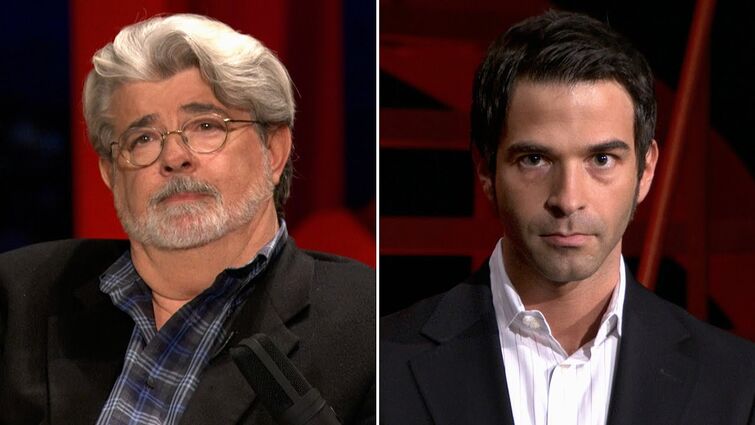
When asked about producing The Clone Wars, Lucas offered a nebulous description of the show and highlighted what seemed like an identity crisis regarding when and where to air it, because television programs on popular channels are organized to air at certain times for their target audiences. That’s why more mature (or immature, depending how you look at it) content airs later at night, when little kids are asleep.

The Clone Wars doesn’t meet that benchmark; obviously, little kids love Star Wars, so it aired on Friday nights. The show still stood out stylistically from the Cartoon Network’s other programs, being part of Star Wars and not adhering to a traditional episodic animation format. It didn’t even cut to black for commercial breaks, so fades were just edited in by the network.
The biggest structural feature of the show was the episode arc it developed over time. This made episodes more slowly paced as well as codependent for proper context—which discourages viewership if not handled properly.
This nonconformism began to narrow the show’s demographic and hurt ratings, which only helped the show’s high budget to hurt profits. The 2016 edition of the Year by Year chronology notes that season five was shifted to Saturday morning premieres to avoid competition with the more adult-oriented late-night cartoons.

Scheduling conflicts are nothing compared to company conflicts, however. The Clone Wars was cancelled because Cartoon Network is owned by Warner Bros., a direct competitor of Disney, which had just bought Lucasfilm at the time.
In short, airing on the Cartoon Network was the problem in the first place for The Clone Wars. The release of the sixth season on Netflix did away with scheduling and demographic issues—subscribers could watch the show whenever they wanted—but it was too little too late, since the show then remained incomplete and would later be moved from Netflix to Disney+.
Rebels aired on Disney XD in 2014, and it showed more signs of adaptivity to network airings. Traditional cuts to black were present, pinning down the pacing of each episode to something more constant.
Issues still plagued airings, however. Disney XD is a crowded channel, with tons of flagship cartoons (highly recommended, by the way) taking up tons of slots, and as a result, no two seasons of Rebels aired on the same day of the week.
Season one aired every Friday.
Season two aired every Wednesday.
Season three aired almost every Saturday; episodes started becoming slightly more sporadic.
Season four aired two episodes every Monday.
The evolution in airing structure was a direct result of the show’s progressively continuous story, which the network tried its best to adapt to serve. All things considered, Rebels concluded with a huge victory for Star Wars television.
Resistance really seemed like it could ride this success too. It aired on the Disney Channel, which is far more accessible than Disney XD. Unfortunately, it’s congested with live-action sitcoms. Cartoons don’t tonally fit or last long there.
Resistance was pushed to possibly the worst time slot a cartoon could air: 10 PM on a Sunday night. There isn’t much else to say on that matter. Television went 1 for 3 on the networks, which isn’t very favorable.
Then came The Mandalorian, the first Star Wars series on Disney+. The first two seasons aired every Friday without a notable hitch. It didn’t have too much competition as the flagship show of the service.
The second Star Wars series to air on Disney+ was the long-awaited return of The Clone Wars. The final season aired on Fridays, but the last episode came early, on May the Fourth, 2020. Only the scheduling freedom of a streaming service could make that sort of accommodation so easily and allow the most revolutionary show in the franchise to conclude on the most honorable day possible.
It seems to be the start of a tradition, since The Bad Batch also premiered on May the Fourth a year later, despite otherwise adhering to the Friday release dates. The show’s existence at all is proof that season seven of The Clone Wars actually managed to turn a significant enough profit for Disney+ to justify a continuation.
The Mandalorian is producing its own share of spin-offs with a significant degree of interconnectivity. Disney+ has already shown its ability to accommodate for this, with recaps of important events from previous episodes of The Mandalorian preceding new ones. This will help tremendously as the groundwork is laid for the impending return of Thrawn.
There’s also less risk in distributing content that doesn’t fit network television at all, especially concerning runtime. A Droid Story will be a full-length animated film, which makes far more sense to put on a streaming service than a network channel.
The same goes for all the old Legends programs of various formats, which are now preserved as part of a vintage collection.
Scheduling changes are still the only risk, but Disney+ looks to be making them proactively, not reactively. Starting with Visions, future Star Wars series will air on Wednesdays. The change looks to be permanent and will retain the right amount of breathing room between Star Wars and other media properties. We’re protected.
TL;DR: Star Wars is too unique for network television.
All its shows in the last decade struggled with the right time slots, age ratings, and contracts with other networks. Disney+ has no limit on runtime, an all-encompassing demographic, and IP ownership to preserve all the content.
Star Wars has secured another place to push the limits of storytelling indefinitely, and we’re lucky to see it.
